Model training
Custom Computer Vision Model Training Services
- Annotation and QA included
- Scores reported per class
- Air-gapped training on request
Labelled instances per class
- person4,200
- hard hat3,100
- hi-vis vest2,700
- forklift380
forklift: under 1,000 examples, collect more
1/4Images are de-duplicated, balanced and split before anyone labels them. Classes with too few examples are flagged early.
How it works
Training is a loop, not a one-off run
Every run tells us which class to collect more data for. That is the work.
- 150+ models delivered
- Proof of concept in 4–6 weeks
- Best checkpoint kept and versioned
- Stage 1
Curate the dataset
Near-duplicates are removed, classes are balanced and the train, validation and test split is fixed before any labelling starts.Clean, split dataset - Stage 2
Annotate and review
Boxes, masks or keypoints are drawn to written guidelines, then a second annotator checks and corrects every frame.Reviewed ground truthCVATRoboflow - Stage 3
Train from a pre-trained checkpoint
Transfer learning cuts how much of your data we need. Architecture and hyperparameters are benchmarked rather than guessed.Tracked training runsPyTorchMLflowWeights & Biases - Stage 4
Evaluate per class and condition
A held-out test set gives a score for every class and capture condition, so a good average can't hide a class the model keeps missing.AP per class, failure cases - Stage 5
Mine hard cases and retrain
Frames the model gets wrong are collected, labelled and fed into the next run. The same loop runs again once the model is live.Next run, measurably better
Architecture
The architecture follows the question
We shortlist by what the decision needs and what your hardware can run, then benchmark on your data.
- YOLO family for real-time detection
- U-Net and Mask R-CNN for exact boundaries
- Vision transformers for context-heavy scenes
- Vision-language models where text and image mix

Data
Accuracy is a data problem first
Most gains come from better labels and the frames nobody thought to collect.
Your own frames
Captured from your cameras, including the awkward ones.Annotation and QA
Written guidelines, then a second reviewer on every frame.Synthetic rare cases
Generated images for defects too rare or risky to film.Active learning
The model flags what it finds confusing; those get labelled next.
Optimisation
Trained to fit the device it runs on
A model is only finished when it hits the frame rate on your hardware.
- Quantisation and pruning to cut size
- Knowledge distillation into a smaller model
- TensorRT, ONNX and Core ML export
- Measured on the target board, not a workstation
| Model | Orin NX, 20 W | AGX Orin, 50 W |
|---|---|---|
| YOLOv8 Nano | 145 FPS | 420 FPS |
| YOLOv10 Nano | 160 FPS | 465 FPS |
| YOLO-World Small | 38 FPS | 115 FPS |
Figures from our YOLO on Jetson tutorial. Your numbers depend on input size and camera count.
Trained models in the field
Where the numbers came from
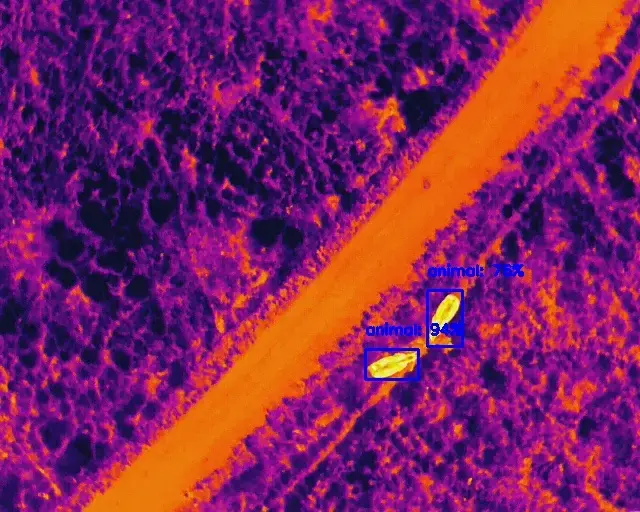 Drone Vision & Wildlife ProtectionComputer Vision
Drone-Based Wildlife Monitoring and Anti-Poaching System
Skaapwagter needed a surveillance system capable of detecting animals from drone footage to protect herds from poachers across large areas.
- Thermal detection accuracy at 100m
- 98%
- RGB species classification accuracy at 50m
- 92%
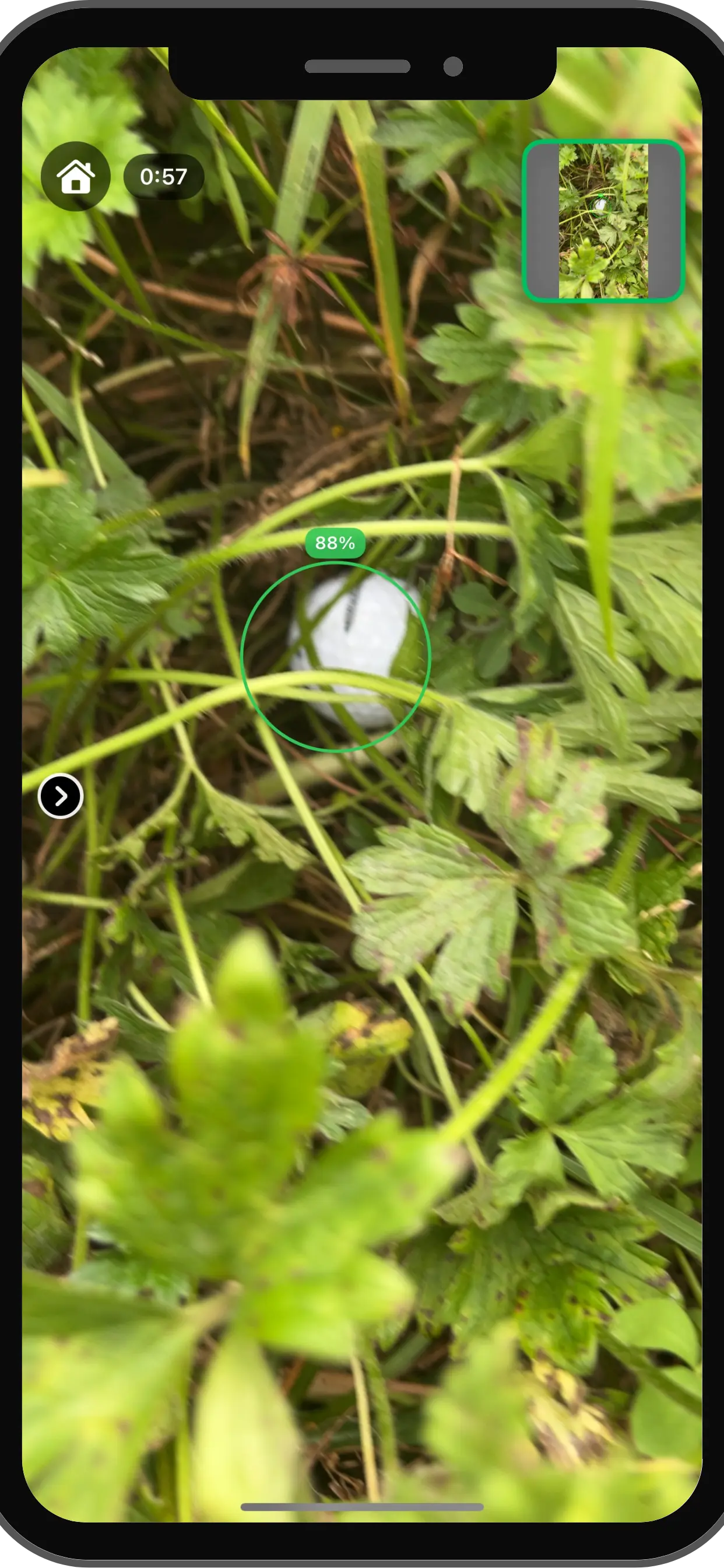 Sports AI & Mobile Computer VisionComputer Vision
Find My Ball: Real-Time AI Golf Ball Detection on Mobile Devices
FMB wanted to build a mobile app that could automatically detect lost golf balls using the phone camera to help golfers quickly locate balls in challenging terrain.
- On-device inference time
- <30ms
- Detection recall
- 92%
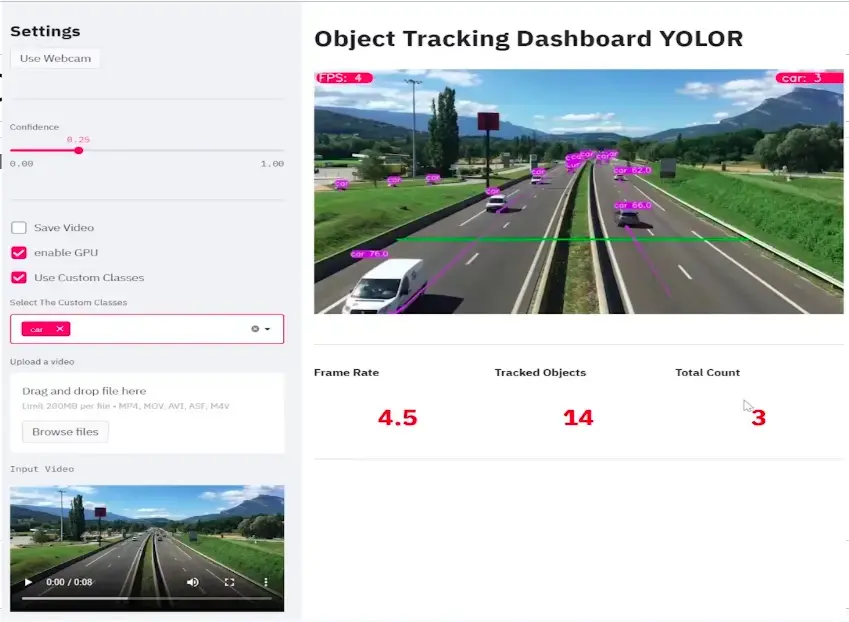 Open Source AI InfrastructureComputer Vision
AS-One: Unified Computer Vision Framework for Rapid AI Development
Augmented Startups wanted to simplify how developers experiment with modern computer vision models by unifying multiple detection and tracking frameworks into a single Python interface.
- GitHub stars on AS-One
- 580+
- Detector versions behind one API
- YOLOv5–v9
Getting started
Start with the data you already have
Training can run in your own cloud account or fully air-gapped on your servers. See private AI deployment and how we handle IP.
Step 1: Data review
30 minutes
We look at a sample of your images and say whether they can support the task yet.
- NDA on request
Step 2: First trained model
4–6 weeks
Annotation, a training run and a test report per class against the agreed target.
- Target set before we start
Step 3: Retraining in production
Ongoing
New failure cases are labelled and folded into scheduled retraining runs.
- You own the weights
FAQ
Questions, answered
What teams ask before handing over a dataset.
Need the whole build, not just training? See custom computer vision models.
Yes. We specialize in computer vision model retraining services to improve computer vision model accuracy as your production data evolves. We identify accuracy bottlenecks and re-train using optimized hyperparameters and targeted data augmentation.
Absolutely. We are a custom object detection training company with specific expertise to train YOLOv8 custom dataset architectures, as well as YOLOv10 and YOLO-NAS, for specialized industrial or commercial use cases.
It depends on the task and how varied your images are. We use transfer learning to keep data requirements low: by starting with models pre-trained on large public datasets, we fine-tune them specifically for your use case, which needs far less data than training from scratch. We assess your existing data early and tell you if more is needed.
Yes. We offer air-gapped local training options and sign strict NDAs. Your data never leaves your secure environment if required. We can deploy our training infrastructure on your on-premise servers or your private cloud instance.
We use Generative AI to create rare-case training images (like accidents or rare defects). This allows us to train models for scenarios that are difficult, dangerous, or impossible to capture in the real world, ensuring your model is robust against outliers.
Yes, we identify accuracy bottlenecks and re-train using optimized hyperparameters. We perform rigorous benchmarking against ground truth datasets to pinpoint classes where the model struggles, then implement targeted data augmentation and retraining.
A typical proof of concept takes 4–6 weeks; full-scale production models take longer, depending on data readiness and scope. The timeline covers data strategy, annotation, initial model selection, hyperparameter tuning, validation, and preparation for deployment.
Yes, we offer end-to-end data management including manual and AI-assisted labeling. We use a multi-stage QA process to ensure ground truth accuracy, employing expert annotators where domain-specific knowledge (like medical or industrial) is required.
Related
Keep exploring
- Computer visionCustom computer vision modelsModels trained on your own images, video and edge cases.
- Computer visionManaged AI servicesMonitoring, retraining and support for models in production.
- Computer visionEdge deploymentModels optimised for NVIDIA Jetson, mobile and on-prem hardware.
- Computer visionComputer vision developmentDetection, tracking, segmentation and OCR systems built for production.
Book a strategy session
Talk to an AI engineer about your project
Tell us what you want to automate. The first call is a 30-minute working session with an engineer, not a sales pitch.
- Send the form, it takes 2 minutes
- We reply within 1 business day, under NDA if you need it
- A 30-minute call to scope feasibility and next steps