Commercial real estate document AI
AI Offering Memorandum Parsing
- Scanned and digital PDFs
- Every value traced to its page
- Excel, Google Sheets, JSON or API
- Cover and disclaimerpp. 1–2Skip
- Investment summarypp. 3–6Extract
- Property overviewpp. 7–10Extract
- Rent rollpp. 11–14Extract
- Operating statement (T-12)pp. 15–18Extract
- Rent and sales comparablespp. 19–26Extract
- Market overviewpp. 27–36Reference
- Photos and site planpp. 37–42Reference
1/4The broker's OM arrives by email, upload or API. Pages are classified so the summary, rent roll, T-12 and comps go to extraction.
Sample OM with a fictional property and figures.
Built for a CRE marketplace
From several hours per OM to under three minutes
We built the OM parsing engine behind Finance Lobby's commercial real estate marketplace. It takes OMs in any broker format and turns them into structured deal data that users can filter and compare.
- OM analysis time, down from several hours
- <3 min
- Accuracy on critical financial fields
- 95%+
- Pages in a typical OM
- 40–150

The underwriting bottleneck
OMs hide the numbers you need in 40 to 150 pages
Speed wins deals, but every OM has to be read, re-keyed into a model and checked before anyone can say yes or no. Analysts spend their time copying tables instead of judging the deal.
Hours per OM
Rent rolls, T-12s and comps are typed into the model by hand, so deal volume is capped by analyst time.No two brokers alike
Every brokerage lays out its OMs differently, so fixed templates and rules break on the next document.Tables defeat basic OCR
Merged cells, subtotals and multi-page rent rolls come out of generic OCR as scrambled text.Context in the narrative
Lease expirations, tenant notes and value-add plans often sit in paragraphs, not tables.
| Topic | Manual OM review | AI OM parsing |
|---|---|---|
| Time per OM | Several hours of reading and re-keying | Under three minutes to structured data |
| Formats | Each new broker layout slows the analyst down | Layout models read structure, not fixed templates |
| Checking | Spot checks against the PDF, if there is time | Every value linked to its page, math checked automatically |
| Deal volume | Limited by how many OMs analysts can read | Screen every OM that arrives, then dig into the best |
How it works
A pipeline that reads an OM the way an analyst does
Layout, tables and narrative are handled by separate models, then merged into one deal record. It is the same intelligent document processing approach we use for other complex documents.
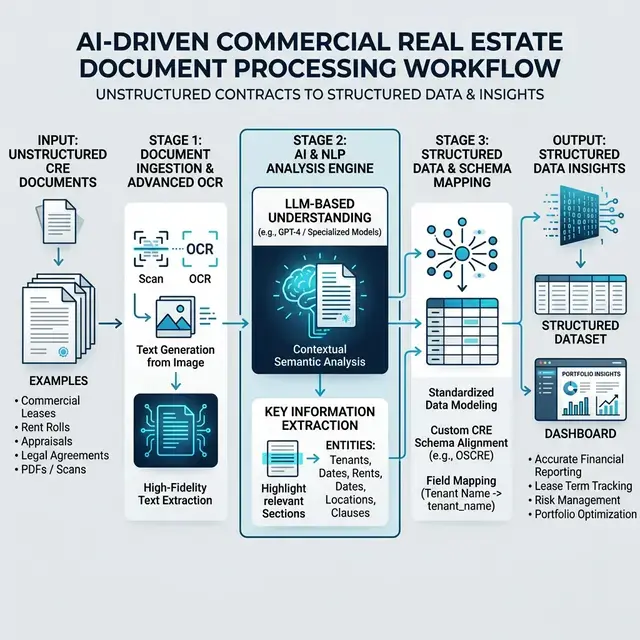
- Stage 1
Ingest and classify pages
OMs arrive by forwarded email, upload or API. Each page is classified, so the investment summary, rent roll, operating statement and comps are routed to the right extractor.Page map of the OM - Stage 2
Clean up scans and run OCR
Scanned or photocopied pages are deskewed and denoised before OCR, so text and numbers keep their position on the page.Text with page coordinatesOCRImage pre-processing - Stage 3
Detect the layout
A layout model separates headers, footers, tables, images and narrative blocks across the whole document.Labelled page regionsLayoutLMv3 - Stage 4
Rebuild the financial tables
Rent rolls, T-12 statements and comp tables are converted into rows and columns, with rules to merge split cells and multi-page tables.Rent roll and T-12 as dataMicrosoft Table Transformer - Stage 5
Read the narrative
A large language model pulls investment highlights, risks and lease notes from the text, citing the passage each answer came from.Deal terms and notes with citationsLLM with source citations - Stage 6
Validate and deliver
Totals are re-added and NOI and cap rate are checked against the inputs. Low-confidence values are flagged, then everything is mapped to your model.Underwriting-ready deal recordExcel / Google SheetsJSON / API
What it extracts
The data your underwriting model needs
We scope fields to your model. These are the sections acquisitions teams ask for most.
Property details
Address and parcel, asset type and class, year built and renovated, zoning, lot size and rentable or gross leasable area.From cover, summary and overview pagesHow AI underwriting worksRent roll
Suites and units, tenant names, square footage, rent and rent per SF, lease start and expiry dates, and fixed or CPI escalations.One row per unit or suiteRent roll and lease intelligenceOperating statement
Gross potential rent, vacancy, taxes, insurance, utilities, CAM and management fees, and net operating income.T-12 and pro forma linesRent and sales comps
Comparable properties with distance, year built, units, rents, price per SF, occupancy and reported cap rates.Ready for cap rate spreadsAI property valuationLease-level detail
When the data room includes the leases themselves, renewal options, CAM caps and other clauses can be abstracted too.Clauses linked to their sectionLease abstractionDeal screening
Structured OM data can feed scoring rules or models that rank incoming deals, so the team reads the best ones first.Scores based on your criteriaDeal prioritisation with AI
In practice
Where parsed OMs land
Forward the broker email, get a filled model
- No new dashboard to log in to
- Works with Excel and Google Sheets templates
- Every value links back to the OM page
Investment summary
Illustrative example with a fictional property. Select a field to see where it was found.
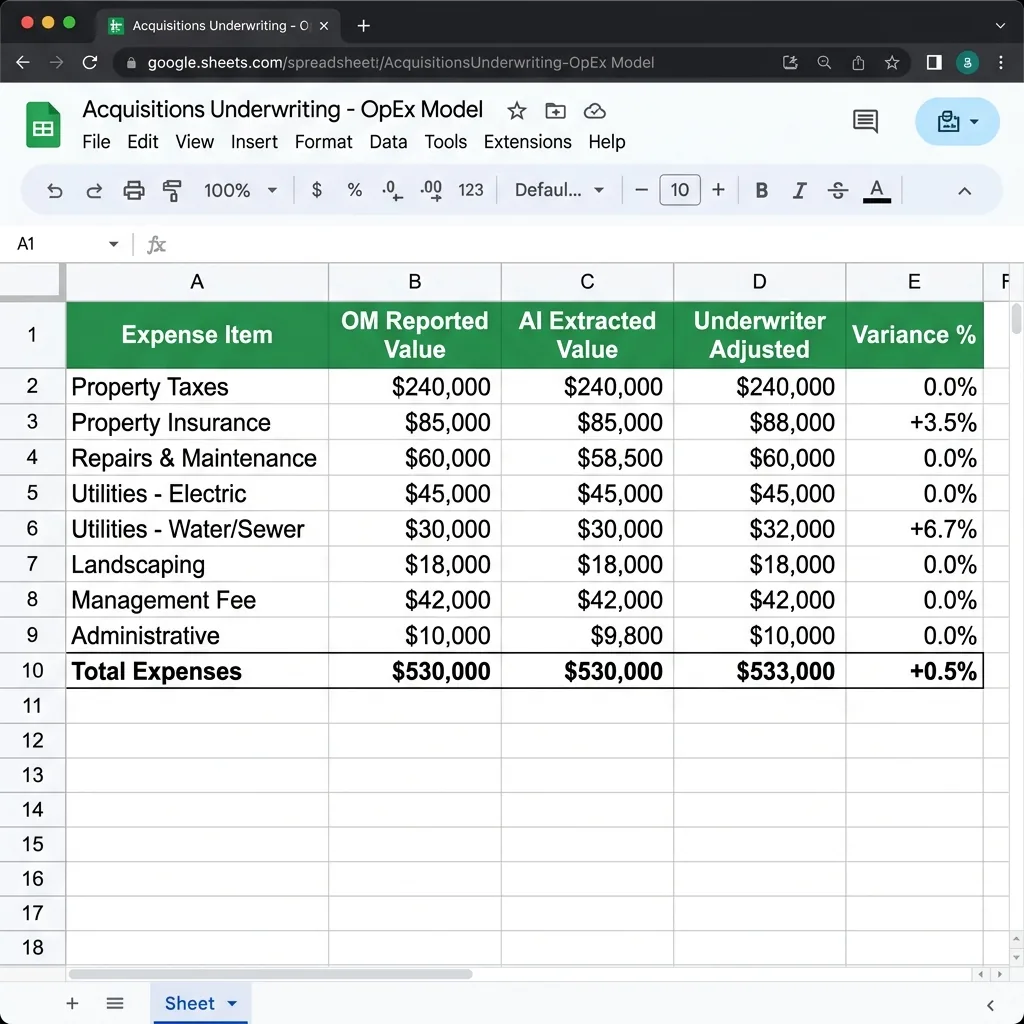
Extracted values next to your adjustments
- OM-reported and adjusted values side by side
- Variance calculated for every line
- Your formulas and tabs stay intact
Fits your stack
Delivered into the tools your acquisitions team already uses
OMs are confidential. The system can run where your data already lives, and it writes to your existing models and databases instead of adding another app.
Need to create OMs rather than read them? See how we generate OMs with AI.
Email, upload or API
Forward broker emails to a parsing inbox, drop files in a portal, or call a REST API.Your spreadsheet model
Fields map to the cells of your Excel or Google Sheets template, formulas untouched.CRM and databases
Connectors for your deal pipeline, CRM or data warehouse, built on their APIs.- Sovereign AI deployment
Private deployment
Run it in your own cloud account or on your servers, with no shared multi-tenant storage.
Getting started
Test it on your own OMs first
Start with a batch of real OMs and your analysts' completed models as the benchmark.
Step 1: Scoping call
30 minutes
We review sample OMs, your underwriting template and the fields you need, and tell you what is feasible.
- NDA on request
Step 2: Proof of concept
4–6 weeks
A working parser on your OMs, measured field by field against your analysts' numbers.
- Accuracy targets agreed up front
Step 3: Production
Ongoing
Connected to your inbox, models and databases, monitored and updated as new broker formats appear.
- You own the IP
Not sure where document AI fits best in your deal process? Start with an AI Opportunity Audit (3–5 business days), or read how we handle security and data protection.
FAQ
Questions, answered
What acquisitions and PropTech teams usually ask before a pilot.
Working with leases as well? See AI lease abstraction.
On the platform we built for Finance Lobby, extraction reached 95%+ accuracy on critical financial fields. We measure accuracy field by field on a sample of your own OMs before anything goes to production, and every value links back to its page and position in the PDF so underwriters can check it in one click.
For Finance Lobby, analysing an OM went from several hours of manual work to under three minutes. The structured rent roll, operating statement and deal terms are then written straight to your underwriting model.
It depends on your monthly OM volume, how many fields and templates you need, and where the system runs. Book a call and we will scope it and send a proposal.
Yes. Extracted fields are mapped to the cells of your own Excel or Google Sheets model, so your tabs, formulas and NOI templates stay as they are.
We build the connector for the systems you already use, for example Dealpath, Yardi, RealPage, Salesforce or your own SQL database or data warehouse, through their APIs. The output is also available as JSON through a REST API.
Yes. Scanned pages are cleaned up first (deskewing and denoising), then OCR and table models such as Microsoft Table Transformer rebuild the rows and columns. Values the models are unsure about are flagged for review rather than guessed.
The pipeline can run inside your own cloud account (AWS, GCP or Azure) or on your own servers, so OMs never go to a shared multi-tenant service. See our sovereign AI page for private deployment options.
Yes. Brokers format OMs very differently, so the system reads document structure rather than relying on fixed templates. It handles residential unit schedules, retail and office rent rolls and their escalations. We test on your asset types during the proof of concept.
Forward the broker email to a dedicated inbox (for example [email protected]), upload PDFs in a simple web portal, or call the REST API from your own tools.
Yes. Support, model updates for new OM formats and uptime commitments are agreed in an SLA for each production deployment.
Related
Keep exploring
- Document AILease abstractionTenants, rent schedules, dates and clauses extracted from lease PDFs.
- Document AIDocument AI (IDP)Invoices, contracts and forms read, validated and routed into your systems.
- PropTechAI property valuationValuation and forecasting models that combine listings, images and layouts.
- IndustriesAI for real estateStaging, image tagging, valuation and document AI for brokerages and PropTech platforms.
Book a strategy session
Talk to an AI engineer about your project
Tell us what you want to automate. The first call is a 30-minute working session with an engineer, not a sales pitch.
- Send the form, it takes 2 minutes
- We reply within 1 business day, under NDA if you need it
- A 30-minute call to scope feasibility and next steps