Commercial lease abstraction
AI Lease Abstraction & OCR
- Scans, amendments and exhibits
- Every value linked to its clause
- Excel, JSON or API
- Art. 1 Basic lease informationpp. 1–3Extract
- Art. 2–3 Term and rentpp. 4–9Extract
- Art. 4 Operating expenses and CAMpp. 10–14Extract
- Art. 5–11 Use, repairs, insurancepp. 15–24Extract
- Art. 12 Option to renewpp. 25–26Extract
- Signature pagepp. 29Reference
- Exhibit A Floor planpp. 30Reference
- Exhibit C Rules and regulationspp. 33–36Skip
1/4The lease, its amendments and exhibits arrive by upload, email or API. Articles and exhibits are classified before extraction.
Sample lease with fictional parties and figures.
Why abstraction is slow
The terms that matter are spread across a hundred pages
Reading a lease and building its abstract takes hours per document. Across a portfolio or an acquisition data room, that means missed renewal windows, uncapped CAM charges and rent rolls that don't match the leases.
Long, layered documents
Base lease, amendments, side letters and exhibits each change terms, and all of them have to be read together.Same clause, different words
“Triple net”, renewal rights and CAM exclusions are drafted differently by every landlord and law firm.Dates that are easy to miss
Notice windows for renewals and terminations are buried in clauses and rarely land in a calendar.Rent rolls drift from leases
Escalations and concessions in the lease don't always match what the rent roll or accounting system says.
| Topic | Manual abstraction | AI lease abstraction |
|---|---|---|
| Time per lease | Hours of reading and typing into a template | Minutes, with people reviewing only flagged fields |
| Consistency | Depends on who abstracted the lease | Same schema and rules for every lease in the portfolio |
| Traceability | Abstract and PDF kept in separate folders | Every value links to its page and clause |
| Critical dates | Copied into calendars by hand, if at all | Notice windows and rent steps exported automatically |
How it works
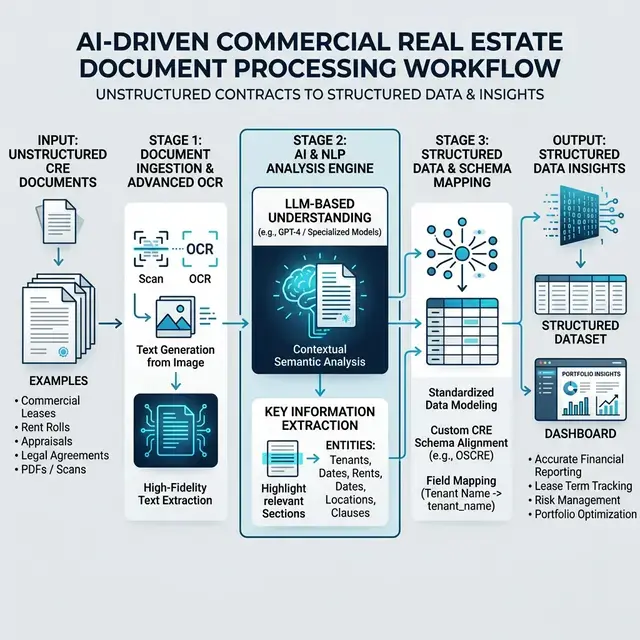
From scanned lease to structured abstract
OCR, layout models and language models each handle the part they are best at. It is our intelligent document processing pipeline, tuned for commercial lease language.
- Stage 1
Intake and classify
Leases, amendments, exhibits and rent rolls arrive by upload, email or API. Each file and section is labelled so amendments are applied to the right base lease.Document set with sections labelled - Stage 2
OCR and layout detection
Scans are deskewed and cleaned up, then OCR and a layout model find clauses, headings and tables with their position on the page.Text and tables with coordinatesOCRLayoutLMv3 - Stage 3
Extract entities and clauses
Language models trained on lease wording identify parties, dates, amounts and clause types such as renewals, exclusives, co-tenancy and assignment, however they are phrased.Fields and clauses with citationsNERLLM - Stage 4
Normalise rent schedules
Base rent tables are rebuilt into rows, and fixed, step-up and CPI escalations are converted into one consistent schedule.Month-by-month rent scheduleMicrosoft Table Transformer - Stage 5
Validate and reconcile
Date logic and maths checks run on every abstract, for example expiration after commencement and rent steps that match the escalation clause. Rent rolls can be compared with the leases.Checked abstract with flags - Stage 6
Review and export
Low-confidence fields go to a reviewer with the source clause highlighted. Approved abstracts are exported to your template or system.Approved lease abstractExcelJSON / API
What it extracts
A complete abstract, not just the first page
We scope the schema to your abstract template. These are the fields asset managers and acquisitions teams ask for most.
Parties and premises
Landlord and tenant entities, guarantors, suite and address, and rentable area in square feet.From the basic lease information and signature pagesBuild a lease abstraction engineDates and term
Commencement, rent start and expiration dates, term length and notice periods for renewals and terminations.Exported as critical datesRent schedule and escalations
Base rent by period, rent per SF, fixed percentage, step-up and CPI escalations, and percentage rent terms.One normalised schedule per leaseHow this feeds underwritingOptions and rights
Renewal and termination options, exclusive use, co-tenancy, assignment and subletting, ROFO and ROFR.Clause text with page referenceLease and contract intelligenceExpenses and recoveries
NNN pass-throughs, CAM inclusions and exclusions, annual or cumulative CAM caps, tax and insurance allocations.Recovery rules per leaseRent roll and OM checks
Compare abstracted terms with the rent roll or the offering memorandum during acquisitions due diligence.Differences flagged per tenantOffering memorandum parsing
In practice
What teams do with abstracted leases
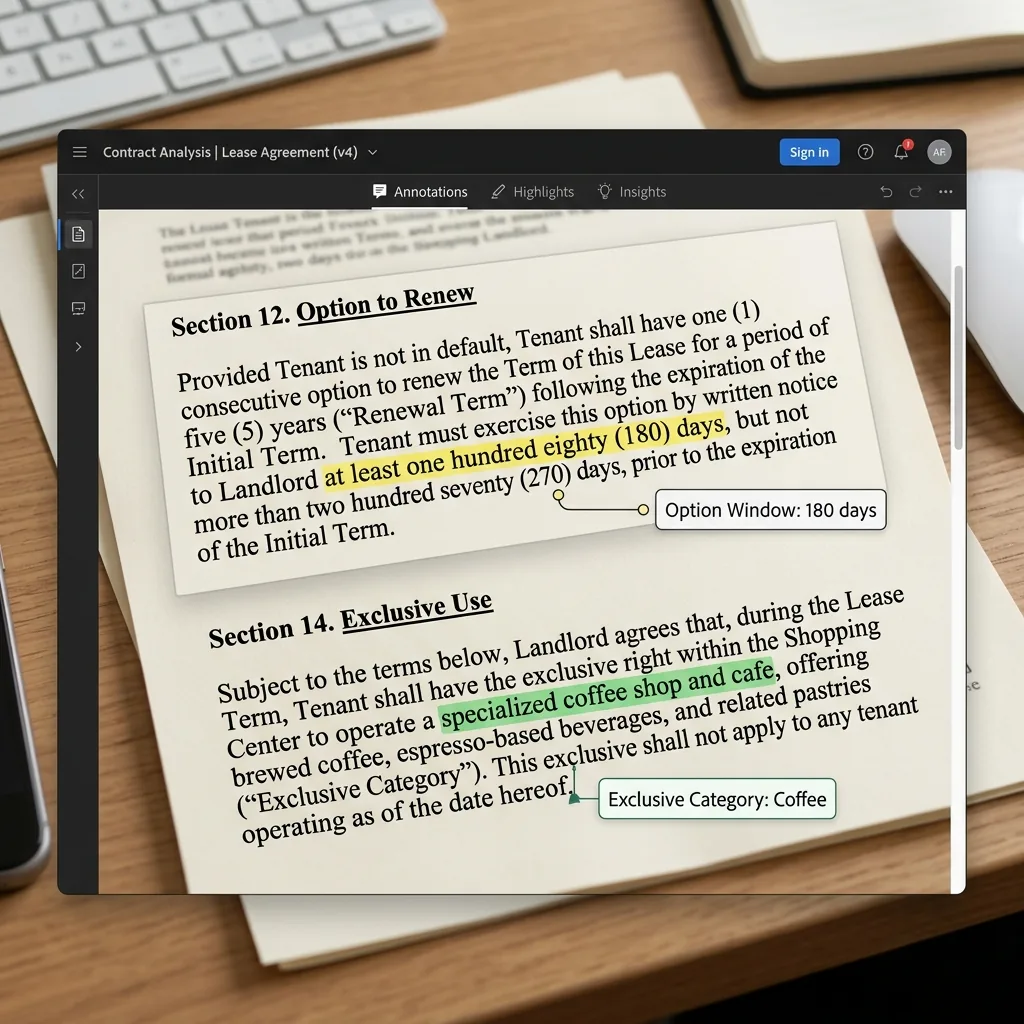
Options and exclusives, found and explained
- Notice window calculated from the clause
- Exclusive use category captured
- Source clause highlighted for review
Critical dates that reach a calendar
- Notice deadlines calculated from the lease
- Rent steps from the normalised schedule
- Each date linked to its article or exhibit
- Mar 1, 2026Lease commencesArt. 1
- Mar 1, 2027Rent steps to $32.96/SFExh. B
- Feb 28, 2030Renewal notice window opensArt. 12
- May 28, 2030Renewal notice deadlineArt. 12
- Feb 28, 2031Lease expiresArt. 1
Generated from the sample lease in the workflow above. Fictional data.
Built on proven document AI
The same engine that parses offering memorandums
For Finance Lobby we built a pipeline that reads commercial real estate OMs in any broker format, combining layout detection, Microsoft Table Transformer and large language models. OM analysis went from several hours to under three minutes, with 95%+ accuracy on critical financial fields. Lease abstraction uses the same building blocks, tuned for lease clauses.

Fits your stack
Abstracts delivered where your lease data lives
Leases are confidential contracts. The system can run inside your own environment and writes to the tools your lease administration, accounting and asset management teams already use.
Upload, email or API
Send single leases or whole data rooms by portal, forwarded email or REST API.Your abstract template
Fields land in your Excel or Google Sheets layout, formulas untouched.Lease admin and ERP
Connectors for property management, accounting and CRM systems, built on their APIs.- Sovereign AI deployment
Private deployment
Run it in your own cloud account or on your servers, with no shared multi-tenant storage.
Getting started
Prove it on your own leases first
Start with a set of real leases and abstracts your team has already completed as the benchmark.
Step 1: Scoping call
30 minutes
We review sample leases, your abstract template and target systems, and tell you what is feasible.
- NDA on request
Step 2: Proof of concept
4–6 weeks
A working abstraction pipeline on your leases, measured field by field against your existing abstracts.
- Accuracy targets agreed up front
Step 3: Production
Ongoing
Connected to your systems, with reviewer workflows, monitoring and updates for new lease formats.
- You own the IP
Want to find the best document AI use cases across your portfolio first? Start with an AI Opportunity Audit (3–5 business days), or read how we handle security and data protection.
FAQ
Questions, answered
What lease administration and acquisitions teams usually ask before a pilot.
Screening deals before the leases arrive? See offering memorandum parsing.
Our document AI reached 95%+ accuracy on critical financial fields in the offering memorandum platform we built for Finance Lobby, and leases run through the same kind of pipeline. We measure accuracy field by field on a sample of your own leases before production, and every value links back to the page and clause it came from.
Minutes rather than hours. Exact time depends on page count, scan quality and how many fields you abstract. We benchmark it on your own leases during the proof of concept, and the abstract and rent schedule are then written straight to your system.
It depends on your lease volume, the number of fields and templates, and where the system runs. Book a call and we will scope it and send a proposal.
Yes. Extracted fields and rent schedules are mapped to your own Excel or Google Sheets template, so your tabs, formulas and NOI models stay as they are.
We build the connector for the systems you already use, for example Yardi Voyager, MRI Software, RealPage, Salesforce or your own SQL database, through their APIs. The abstract is also available as JSON through a REST API.
Yes. Scanned and photocopied pages are deskewed and cleaned up before OCR, and table models such as Microsoft Table Transformer rebuild rent schedules into rows and columns. Values the models are unsure about are flagged for review rather than guessed.
The pipeline can run inside your own cloud account (AWS, GCP or Azure) or on your own servers, so leases never go to a shared multi-tenant service. See our sovereign AI page for private deployment options.
Yes. Support, model updates for new lease formats and uptime commitments are agreed in an SLA for each production deployment.
Related
Keep exploring
- Document AIOffering memorandum parsingRent rolls, financials and deal terms pulled from OMs in minutes.
- Document AIDocument AI (IDP)Invoices, contracts and forms read, validated and routed into your systems.
- LLMs & agentsSovereign AIPrivate LLMs and vision models on your own servers, VPC or air-gapped network.
- IndustriesAI for real estateStaging, image tagging, valuation and document AI for brokerages and PropTech platforms.
Book a strategy session
Talk to an AI engineer about your project
Tell us what you want to automate. The first call is a 30-minute working session with an engineer, not a sales pitch.
- Send the form, it takes 2 minutes
- We reply within 1 business day, under NDA if you need it
- A 30-minute call to scope feasibility and next steps