B2B software buying has moved earlier and out of sight. Before anyone books a demo, they have usually asked colleagues, searched Reddit, read a LinkedIn thread, and checked what people in their role recommend. By the time they reach a vendor's website, the shortlist is often set.
Those earlier conversations are public. For a SaaS company, finding them is one of the few ways to influence a decision before the buyer arrives with their mind half made up.
Where SaaS buyers talk
The platforms matter less than the communities on them:
- Reddit: role- and industry-specific subreddits where people ask what tools their peers use, often with very specific requirements. See finding buying signals on Reddit.
- LinkedIn: posts and comment threads where professionals ask their network for recommendations, and where complaints about vendors are surprisingly candid.
- X: founders and operators asking for tools in public, and complaining loudly when one fails them.
- Communities on Facebook, Instagram and TikTok: less obvious for B2B, but significant for SaaS aimed at small businesses, creators and solo operators.
The right mix depends on who buys your product. A developer tool and a bookkeeping tool for salons will find their buyers in very different places.
The signals worth listening for
Recommendation requests in your category, including the ones that never name the category. "How do you all manage client onboarding?" is a buying conversation for an onboarding tool.
Alternatives to your competitors, especially after a price or packaging change, which tends to produce a burst of switching conversations. Covered in turning competitor complaints into customers.
Integration and workflow questions. "Does anything connect X to Y?" points at a gap you may already fill, or should.
Questions about your own product, which, unanswered, become the impression a prospect reads in search results months later.
Churn signals from your own customers, posted publicly instead of to support.
Why keyword alerts fall short for SaaS
SaaS categories have generic names. "CRM", "project management" and "analytics" appear in thousands of posts a day that have nothing to do with buying. Meanwhile, the most valuable posts describe a workflow problem in the buyer's own words and mention no category at all.
That is exactly where intent classification earns its keep: reading each post for what the author is trying to do, rather than which words appear. The mechanics are covered in why keyword alerts miss buying intent.
Turning conversations into pipeline
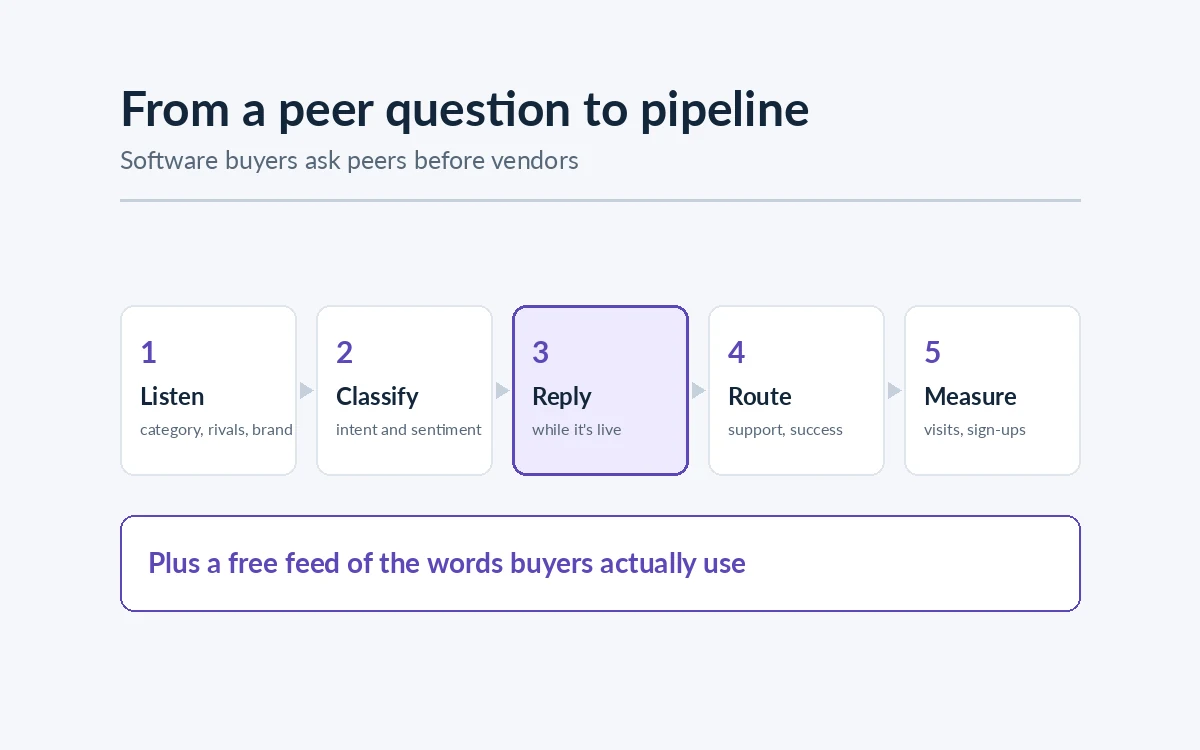
The workflow that works for most SaaS teams:
- Listen across your category's problem language, your competitors' names, and your own brand, on the platforms your buyers use.
- Classify every post: recommendation request, competitor complaint, question, support issue or noise.
- Reply quickly and usefully to the high-intent ones, while the thread is still active, with someone approving each reply. The rules for doing that without spamming are in replying to social posts with AI without being spam.
- Route support issues to support and churn signals to customer success.
- Measure which replies lead to site visits, sign-ups and conversations, so effort goes where it pays.
The second payoff: product and positioning
Listening data is as useful to product and marketing as it is to sales. Aggregated over a quarter, it shows:
- The words buyers actually use to describe the problem, which are frequently not the words on your homepage.
- The reasons people leave your competitors, which is a ready-made list of what to emphasise, and what to build.
- Recurring integration requests and workflow gaps.
- How your launches and price changes are received, in public, unprompted.
For an early-stage company in particular, this is cheap, continuous customer research.
Getting started
A one-week manual test is enough to know whether this channel works for you. Pick the two platforms where your buyers are most likely to talk, search for how they describe the problem you solve (not your category name), and count the genuine buying conversations you find, and how many your brand joined.
If the count is meaningful, the next constraint is reading time. That is the part worth automating.
How AxcelerateAI Helps
AxcelerateAI's social listening and engagement system is built for teams finding demand in public conversations:
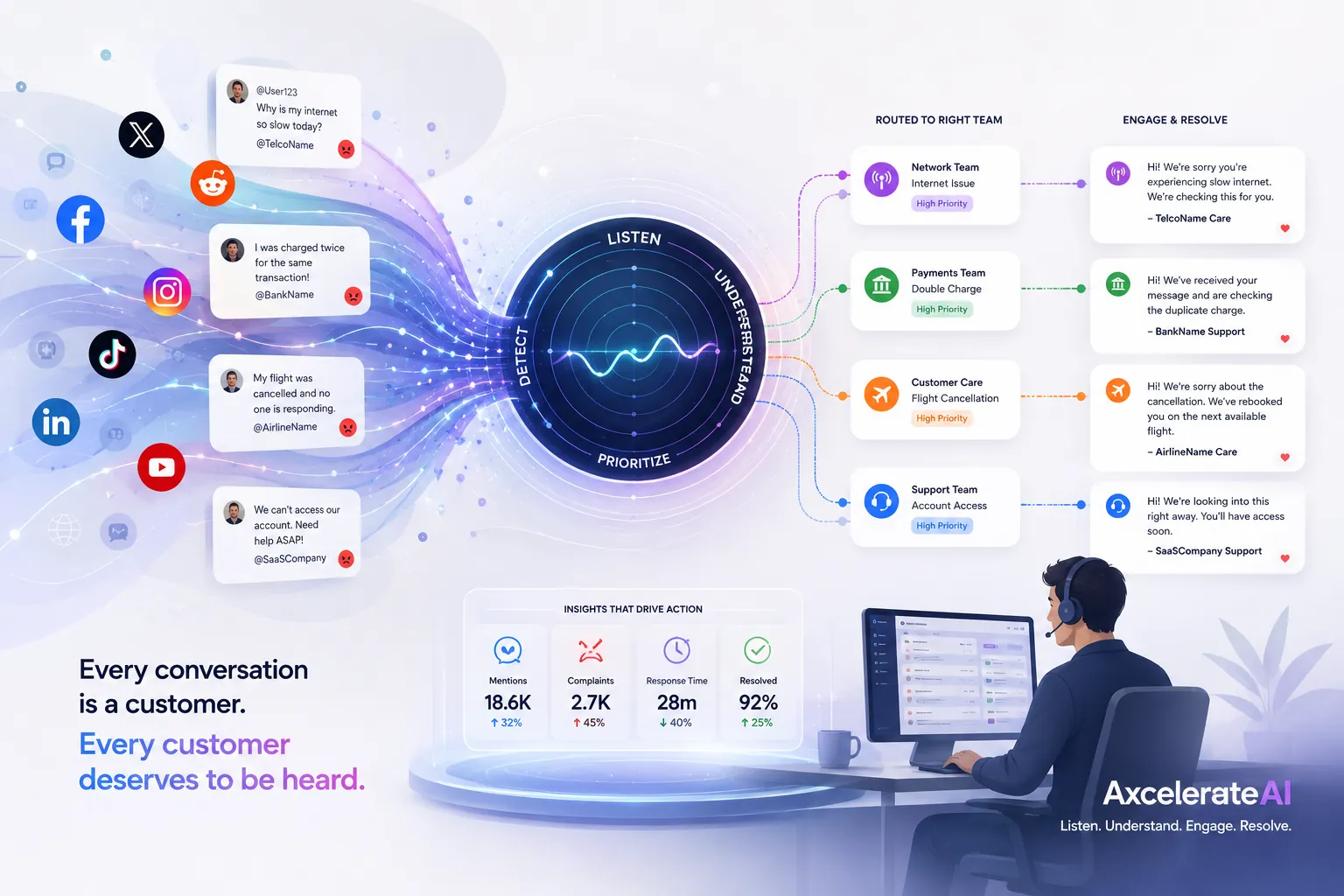
- Listening across Reddit, X, LinkedIn, Instagram, Facebook and TikTok for your category, competitors and brand.
- Intent classification that separates recommendation requests and switching signals from noise.
- Replies in your brand voice, approved by your team before they post, and reporting on what engagement drives.
Get a free report of the buying conversations your brand missed.