When someone posts that a product has let them down, they usually say exactly why: the price went up, a feature was removed, support stopped answering, it does not scale past a certain size. They have also, by definition, already decided to pay for something in your category.
That combination, a qualified buyer with a stated reason to leave, is about as close to a warm lead as public data gets. Most brands never see these posts, and the few who do often reply badly.
Why these posts are unusually valuable
A competitor complaint answers the questions a sales team spends calls trying to learn:
- Budget: they already pay for something in your category.
- Need: they are using the category, so the need is proven.
- Pain: they have told you, in their own words, what is wrong.
- Timing: frustration is highest at the moment they post.
Compare that with a cold prospect, where every one of those is a guess.
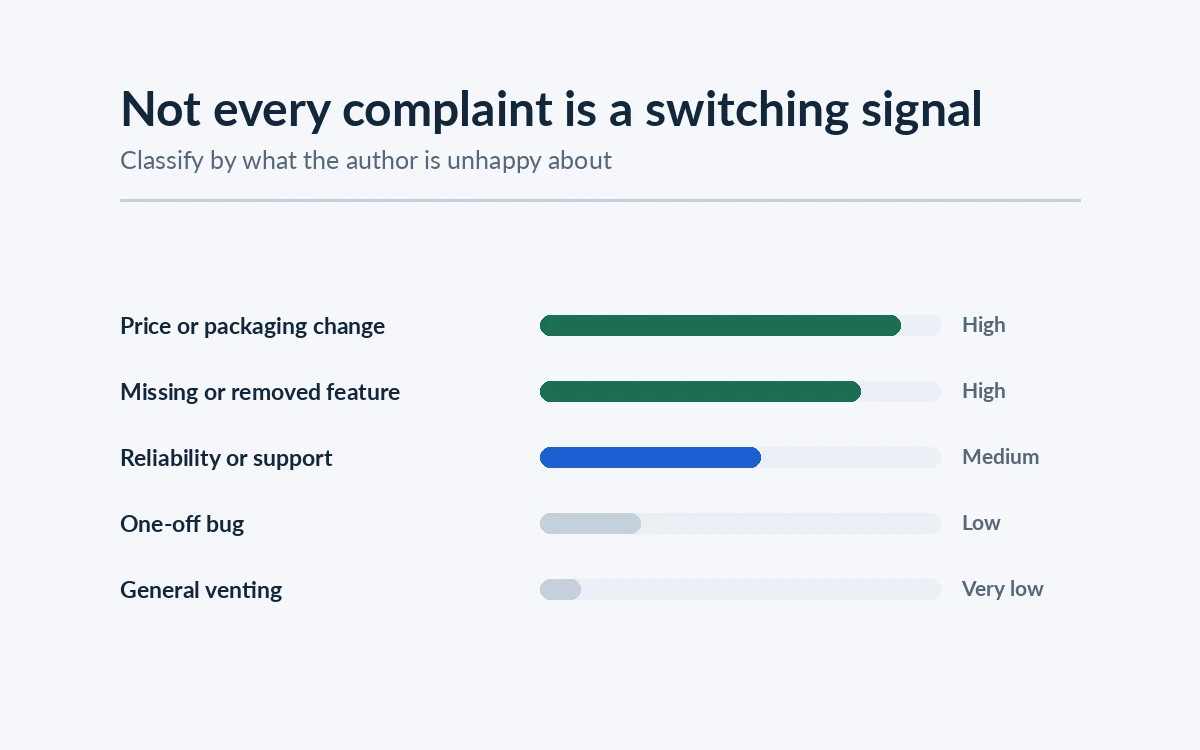
Not every complaint is a switching signal
A complaint is not automatically an opportunity. The categories behave differently:
| Complaint type | Example | Switching likelihood |
|---|---|---|
| Price or packaging change | "The new plan doubled our bill." | High: a concrete, recurring reason to leave |
| Missing or removed feature | "They dropped the API we relied on." | High if you have it |
| Reliability or support | "Down again, and no reply for three days." | Medium: depends on whether it is a pattern |
| One-off bug | "This export button is broken today." | Low: likely fixed tomorrow |
| General venting | "Software is so frustrating." | Very low |
Classifying complaints this way, by what the author is actually unhappy about, is what separates a useful queue from a list of angry posts. Keyword alerts on a competitor's name cannot make the distinction, for reasons covered in why keyword alerts miss buying intent.
Where to find them
- Alternatives threads on Reddit and in community forums: "alternatives to [Competitor]" is one of the most explicit buying signals on the internet. See finding buying signals on Reddit.
- Replies to the competitor's own posts on X, LinkedIn and Instagram, where customers complain directly to the brand.
- Industry communities and LinkedIn discussions, where professionals compare tools with peers.
- Review-style threads, where people ask "has anyone actually used X long-term?"
How to reply without being crass
The fastest way to waste one of these posts is to treat it as an ad opportunity. "Sorry to hear that! Try us instead 🚀" reads as opportunistic, invites a pile-on, and often makes your brand the subject of the next complaint.
Replies that work follow a few rules:
Lead with the problem, not your product. Acknowledge what went wrong in specific terms. If there is a workaround within their current tool, say so: it costs you nothing and earns more trust than any pitch.
Never attack the competitor. Do not pile on, speculate about their business, or make claims you cannot support. Other readers include the competitor's satisfied customers and, frequently, the competitor's team.
Be specific about fit. "We handle that differently: our plans are priced by X rather than Y" is useful. "We're better" is not.
Be honest about what you do not do. If your product would not solve their specific issue, say so or do not reply. Being caught overselling in public is expensive.
Disclose who you are. Every reply makes clear you work for the alternative being mentioned.
Mind the timing. A complaint at the height of an outage is a bad moment for a pitch. Sometimes the right reply is simply helpful, with no mention of your product at all, and the goodwill pays off later.
Turning it into a repeatable process
A workable process for most teams:
- Track your main competitors' names, their product names, and common "alternative to" phrasings across the platforms your buyers use.
- Classify each complaint by type, and route the high-likelihood ones (price changes, removed features, persistent reliability problems) to a person quickly.
- Draft a reply specific to the complaint, following the rules above, and have someone approve it before it posts.
- Watch for clusters. A sudden spike in complaints about one competitor's price change is a market event, and worth a response beyond individual replies: a comparison page, a migration guide, an offer for switchers.
- Feed it back to product. The reasons people leave competitors are a free roadmap of what the market wants.
That last point is easy to overlook. Competitor complaints are as valuable as product research as they are as leads.
How AxcelerateAI Helps
AxcelerateAI's social listening and engagement system flags competitor dissatisfaction as a high-intent opportunity:
- Competitor mention tracking across Reddit, X, LinkedIn, Instagram, Facebook and TikTok.
- Classification of each post by intent and sentiment, so switching signals are separated from venting.
- Polite, specific replies drafted in your brand voice, with your team approving before anything posts.
See the competitor complaints your brand could have answered.