Most teams start social listening the same way: a list of keywords, an alert for each, and someone assigned to read what comes back. Within a few weeks the alerts are being skimmed, then ignored. The usual conclusion is that social listening does not work for their market.
The more accurate conclusion is that keyword matching does not work for finding intent. It was never designed to. This piece explains why, and what the alternative looks like in practice.
Failure one: the buyers do not use your words
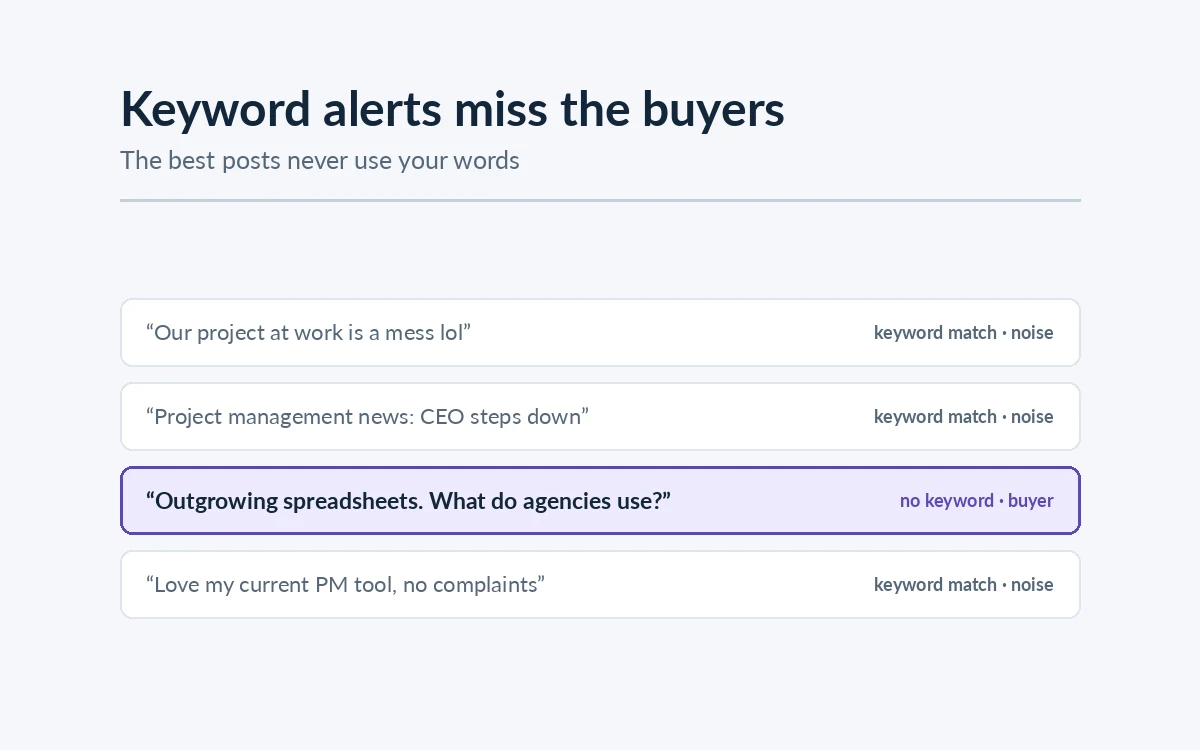
People describe problems, not product categories. Someone who needs invoicing software writes:
"We're outgrowing spreadsheets for billing. What do small agencies use?"
There is no "invoicing software" in that sentence, no brand name, no competitor. A keyword list built from your product's vocabulary misses it entirely, and that post is close to the most valuable thing a listening system could find: an explicit request for a recommendation from someone in your target segment.
You can try to anticipate every phrasing, and teams do. The list grows to hundreds of terms, each one adds more noise than signal, and it still misses the next way someone describes the problem.
Failure two: the posts that match are mostly noise
The reverse problem is worse. Category words are common words. A keyword alert for a project management tool fires on:
- people complaining about a project at work
- news articles about a company's management changes
- jokes and memes using the same terms
- existing happy customers of your competitor, who are not shopping
- other vendors promoting themselves
None of those are buyers. A person reading the feed has to discard almost everything to find the few posts worth a reply, and human attention runs out long before the feed does.
Failure three: keywords cannot read intent
Even when a post is relevant, a keyword cannot tell you what the person wants. These three posts all mention the same competitor:
- "Anyone switched off [Competitor]? Their pricing change killed it for us."
- "[Competitor] just shipped a great update, really happy with it."
- "How do I export my data from [Competitor]?"
The first is someone actively looking to switch. The second is a satisfied customer. The third might be either, and context decides it. To a keyword alert, they are identical.
What intent classification does instead
The alternative is to read each post the way a person would, and label what the author is trying to do. A language model classifies each post into categories such as:
| Label | What it means | Typical response |
|---|---|---|
| Recommendation request | Asking what to buy or use | Reply with a genuinely useful suggestion |
| Competitor complaint | Unhappy with an alternative | Acknowledge the problem; offer an option |
| Buying signal | Evaluating, comparing, budgeting | Reply or route to sales |
| Question | Asking how something works | Answer it |
| Support issue | Your customer, with a problem | Route to support |
| Noise | Not relevant | Discard |
Alongside the label, the model assigns sentiment and a relevance score, so the queue can be sorted by what matters most rather than by when it was posted.
The important property is that classification works on meaning, not vocabulary. The "outgrowing spreadsheets" post is labelled a recommendation request because of what it asks, not because of which words it contains.
Keywords still have a job
None of this makes keywords useless. They are the right tool for the first, cheap stage of the pipeline: casting the net. Brand names, competitor names, category terms and the long-tail phrases buyers use define the space worth collecting from.
The mistake is using keywords for the second stage too, deciding which collected posts matter. That decision needs reading comprehension, which is what classification provides.
A practical pipeline looks like this:
- Collect broadly using keywords, competitors and category phrases, on the platforms where your buyers talk.
- Filter cheaply, dropping obvious noise before any model runs.
- Classify every remaining post for intent, sentiment and relevance.
- Queue by priority, so the highest-intent conversations are read first, while the thread is still active.
How to tell if your current setup has this problem
A quick diagnostic for an existing keyword-based setup:
- What fraction of last week's alerts did anyone act on? If it is a small minority, the alert is producing noise, and the team is filtering by hand.
- Search the platform manually for the problem you solve, described in plain language rather than your product's terms. Count how many genuine buying conversations your alerts never surfaced.
- How old are posts by the time someone reads them? If the answer is days, the recommendation threads have already been decided.
If two of those three point the wrong way, the issue is not your market. It is string matching.
Where this leads
Classification turns listening from a firehose into a queue. The next question is what to do with the queue, and the answer is usually to reply, quickly and well. Two posts go further: finding buying signals on Reddit, where recommendation requests are especially common, and turning competitor complaints into customers. The basics of the whole approach are in what AI social listening is.
How AxcelerateAI Helps
AxcelerateAI's social listening and engagement system classifies every collected post as it arrives:
- Intent labels: buying signal, recommendation request, competitor complaint, question or support issue.
- Sentiment and a relevance score for every post, so the queue is sorted by priority.
- Replies drafted in your brand voice, with human approval before anything is published, if you want it.