Computer vision is no longer an experimental branch of artificial intelligence reserved for research labs and large tech companies. In 2026, it has become a practical business technology used in manufacturing, logistics, healthcare, retail, agriculture, smart cities, fintech, automotive systems, and security operations.
At the same time, one of the most common questions companies still ask is deceptively simple:
“How much does computer vision development actually cost?”
The honest answer is that computer vision pricing varies dramatically depending on the problem being solved, the deployment environment, the quality requirements, and the operational scale. A lightweight object detection system for warehouse inventory management may cost a few thousand dollars to prototype, while a production-grade multi-camera industrial inspection platform can easily cross six or seven figures over its lifecycle.
The challenge is that many online articles oversimplify computer vision development into generic software pricing estimates. Real-world computer vision systems involve significantly more moving parts:
- Data collection pipelines
- GPU infrastructure
- Edge devices
- Annotation workflows
- Model training and retraining
- Latency optimization
- Video streaming systems
- MLOps infrastructure
- Monitoring and drift management
- Compliance and security requirements
In 2026, the cost conversation has also changed because the industry itself has changed. Open-source models are stronger, cloud GPU pricing has evolved, edge AI hardware has become more capable, and multimodal AI systems are reducing some development effort. However, expectations have also increased. Businesses no longer want simple demos. They want reliable, production-ready systems that can operate continuously in real operational environments.
This article breaks down the actual cost structure of computer vision development in 2026 from both engineering and business perspectives.
Where the money goes
Total cost of ownership
Enterprise CV system
Data & annotation
- Ingestion pipelines
- Human-in-the-loop validation
Infra & compute
- Cloud GPU clusters
- Edge acceleration
- Real-time streaming
Multidisciplinary talent
- ML & vision engineers
- Data annotators & QA
MLOps & lifecycle
- Drift monitoring
- Retraining loops
- Security controls
Why Computer Vision Projects Become Expensive
The biggest misconception about computer vision is that the AI model itself is the product.
In reality, the model is often only one component of the system.
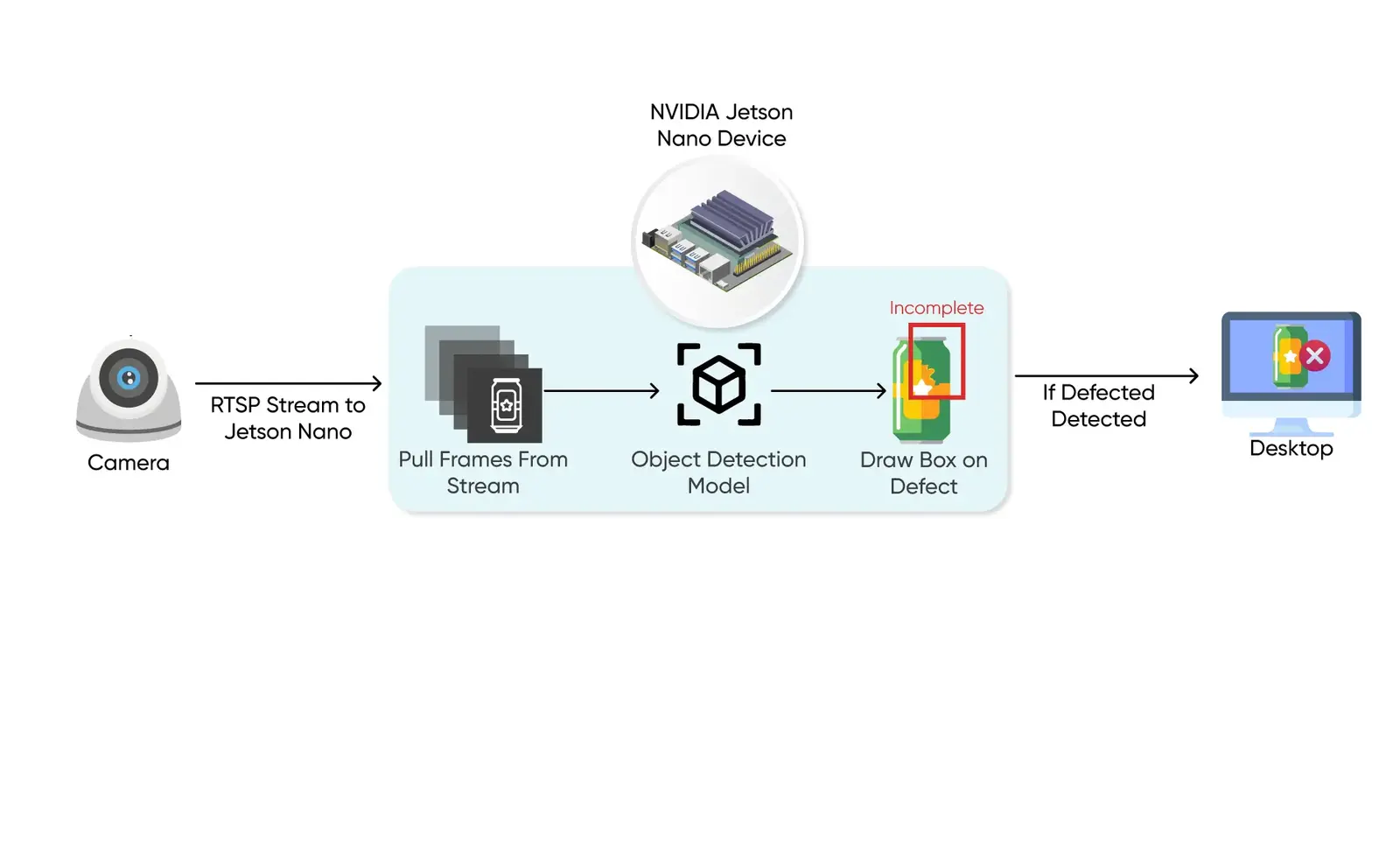
A production-grade computer vision application usually includes:
- Camera infrastructure
- Data ingestion pipelines
- Video processing systems
- AI inference services
- Databases and storage
- Monitoring dashboards
- Edge deployment components
- APIs and backend services
- Security layers
- Operational tooling
The complexity grows even further when systems must process real-time video streams instead of static images.
For example:
- Detecting defective bottles on a manufacturing line
- Monitoring PPE compliance in industrial facilities
- Tracking vehicle movement in smart traffic systems
- Identifying suspicious activity in surveillance systems
- Monitoring crop health using drone imagery
These are not “just AI models.” They are distributed systems with AI embedded inside them.
This is why many companies underestimate cost during the planning phase.
The total system scope vs. the AI core
Intelligence layer
AI inference model
Only ~15% of total system
- Databases & storage
- API & backend services
- Monitoring & dashboards
Main Factors That Influence Computer Vision Development Cost
1. Problem Complexity
The type of vision task significantly changes development cost.
A simple image classification system is much cheaper than a real-time multi-object tracking platform.
Common computer vision tasks include:
| Task Type | Relative Complexity |
|---|---|
| Image classification | Low |
| Object detection | Medium |
| OCR and document parsing | Medium |
| Segmentation | Medium to High |
| Pose estimation | High |
| Multi-camera tracking | High |
| Real-time video analytics | Very High |
| 3D reconstruction | Very High |
A basic image classifier may require:
- Smaller datasets
- Less GPU time
- Simpler deployment pipelines
Meanwhile, real-time video analytics systems require:
- Continuous stream processing
- Lower latency infrastructure
- GPU inference optimization
- Larger compute budgets
- Advanced monitoring systems
In practice, infrastructure requirements often grow faster than model complexity itself.
2. Dataset Collection and Annotation
Data remains one of the largest hidden costs in computer vision development.
Most organizations do not already possess production-quality labeled datasets.
This creates several cost layers:
Data Collection
Companies may need:
- Camera installations
- Drone footage
- Industrial sensors
- Mobile capture systems
- Video acquisition pipelines
For industrial environments, even capturing usable footage can take weeks because lighting conditions, motion blur, environmental noise, and camera angles heavily affect model quality.
Data Annotation
Computer vision models require labeled data:
- Bounding boxes
- Segmentation masks
- Keypoints
- OCR labeling
- Temporal annotations for video
Annotation costs scale aggressively with complexity.
For example:
- Basic image classification labels are relatively cheap
- Pixel-level segmentation is extremely labor-intensive
- Video annotation is often the most expensive category
In 2026, automated labeling tools and foundation vision models help reduce costs, but human validation is still required for production-grade systems. This is especially true in healthcare imaging, manufacturing quality control, autonomous systems, and financial compliance applications, where false positives and false negatives have direct operational consequences. For a detailed breakdown of annotation and pipeline licensing fees, check out our Cost Breakdown of Building a Computer Vision System.
Infrastructure Costs in 2026
Infrastructure is one of the biggest differentiators between prototype projects and production systems.
What are the cloud GPU costs for computer vision training in 2026?
Cloud GPU rates for computer vision training range from $0.90 per hour for mid-range accelerators like the NVIDIA L40S to $4.76 per hour for high-end NVIDIA H100 instances, depending on hosting providers.
| Accelerator Type | Memory | On-Demand Cloud Rate | Typical Training Workload Suitability | Reference / Source |
|---|---|---|---|---|
| NVIDIA H100 | 80GB HBM3 | $2.20 – $4.76 / hr | Large-scale Vision-Language Models (VLMs) | Lambda Labs & RunPod 2026 rates |
| NVIDIA L40S | 48GB GDDR6 | $0.90 – $1.50 / hr | Mid-range YOLO fine-tuning & image generation | Lambda Labs & RunPod 2026 rates |
| NVIDIA Jetson Orin | 64GB (Edge) | N/A (CapEx: ~$2,199 purchase) | Embedded edge inference (drones/robotics) | NVIDIA developer store |
Training modern vision models requires GPU infrastructure. Popular hardware includes NVIDIA H100, H200, RTX 6000 Ada, L40S, and custom Edge AI accelerators.
Training expenses depend on:
- Dataset size
- Model architecture
- Resolution
- Training duration
- Hyperparameter optimization cycles
Even with improved efficiency in 2026, GPU compute remains expensive for large-scale training.
"Initial development costs are only a portion of the investment. Continuous data operations and scaling cloud inference often represent over 60% of a system's total cost of ownership." — Shehryar Malik, CEO at AxcelerateAI.
Companies typically choose between:
| Infrastructure Approach | Advantages | Tradeoffs |
|---|---|---|
| Cloud GPUs | Fast setup, scalable | Long-term operational cost |
| On-prem GPU servers | Lower long-term cost | Higher upfront investment |
| Hybrid deployment | Flexibility | Operational complexity |
For startups and mid-sized businesses, cloud infrastructure is usually preferred during early experimentation because it avoids major capital expenditure.
However, enterprises with continuous workloads often migrate portions of inference or training infrastructure on-premises to reduce recurring costs.
Edge AI Deployment Costs
A major trend in 2026 is edge computer vision deployment.
Instead of sending every video stream to the cloud, inference increasingly happens near the camera itself.
This reduces:
- Latency
- Bandwidth usage
- Cloud compute bills
- Privacy risks
Edge deployment often uses:
- NVIDIA Jetson devices
- Intel OpenVINO systems
- Qualcomm AI platforms
- Custom ARM-based accelerators
However, edge deployment introduces new engineering challenges:
- Thermal constraints
- Limited memory
- Model quantization
- Device orchestration
- Remote updates
- Hardware failures
As a result, edge systems may reduce cloud costs while increasing operational engineering complexity.
Development Team Costs
Computer vision projects are multidisciplinary.
A serious production deployment usually involves multiple roles:
| Role | Responsibility |
|---|---|
| ML Engineer | Model training and optimization |
| Computer Vision Engineer | Vision pipeline design |
| Backend Engineer | APIs and infrastructure |
| MLOps Engineer | Deployment and monitoring |
| DevOps Engineer | Cloud and infrastructure |
| Data Annotators | Dataset labeling |
| QA Engineers | System validation |
| Product/Domain Experts | Operational alignment |
Many early-stage companies assume one AI engineer can handle everything.
In reality, production deployments often fail because infrastructure engineering, monitoring, and operational integration were underestimated.
In 2026, talent costs remain one of the largest budget categories because experienced computer vision engineers are still relatively scarce compared to general software developers.
Typical Computer Vision Development Cost Ranges in 2026
The following estimates represent realistic industry-level ranges for development, excluding ongoing operational scaling.
| Project Type | Estimated Cost Range |
|---|---|
| Proof of Concept (PoC) | $5,000 – $30,000 |
| MVP Vision Application | $30,000 – $120,000 |
| Production Single-Use System | $100,000 – $500,000 |
| Enterprise Multi-Camera Platform | $500,000 – $2M+ |
| Autonomous or Safety-Critical Systems | Multi-million dollar budgets |
These numbers vary heavily depending on:
- Accuracy expectations
- Real-time requirements
- Number of cameras
- Geographic deployment scale
- Compliance obligations
- Integration requirements
For example, a warehouse counting system may be relatively inexpensive, whereas a hospital diagnostic imaging system requires far stricter validation and compliance processes, which dramatically increases development and testing costs. To determine if these costs fit your organization's budget, read our strategic guide: Is Computer Vision Worth It for Small and Mid-Sized Companies?. For customer-facing systems like AI Product Recommendations using Computer Vision, indexing and recommendation models must scale with catalog size, which can affect MLOps deployment costs.
The Hidden Cost of Real-Time Video Processing
Real-time systems are substantially more expensive than image-based systems.
Why?
Because video introduces:
- Continuous inference
- Frame synchronization
- Stream buffering
- GPU scheduling
- Multi-stream concurrency
- Latency constraints
A single image uploaded by a user is easy to process asynchronously.
But processing:
- 500 surveillance cameras
- 30 FPS streams
- Under low latency constraints
- With centralized monitoring
Becomes a distributed systems engineering challenge rather than just an AI problem.
This is where costs escalate rapidly.
Model Accuracy vs Business Cost
One of the most overlooked realities in computer vision is the cost curve of accuracy improvement.
Getting a model from:
- 70% to 85% accuracy may be relatively manageable
- 85% to 92% becomes harder
- 92% to 97% can become disproportionately expensive
Accuracy vs. business cost
Tier 1: Baseline
70% - 85% Accuracy
Manageable investment
- Pre-trained models
- Small datasets
- Low GPU compute
Tier 2: Production
85% - 92% Accuracy
Linear cost scaling
- Custom fine-tuning
- Manual edge validation
- Targeted data collection
Tier 3: Mission critical
92% - 97%+
Exponential cost spike
- Massive domain edge-cases
- Pixel-level data masking
- Intensive hyper-sweeps
Key takeaway: the final 5% of accuracy can cost more than the first 90%.
The final few percentage points often require:
- More diverse datasets
- Better labeling quality
- Domain-specific tuning
- More compute
- More testing cycles
- Better hardware
This is important for executives because business requirements should define acceptable accuracy thresholds.
In many real-world deployments:
- “Good enough and operationally stable” is more valuable than “state-of-the-art but fragile.”
MLOps and Maintenance Costs
Computer vision systems are not static products.
They require continuous maintenance.
Over time:
- Camera positions change
- Lighting conditions shift
- Product packaging evolves
- Environmental conditions vary
- User behavior changes
This causes model drift.
In 2026, production-grade vision systems usually include:
- Monitoring pipelines
- Automated retraining workflows
- Dataset versioning
- Inference analytics
- Logging infrastructure
- Rollback systems
MLOps has become one of the largest operational cost categories because businesses now expect AI systems to behave like reliable infrastructure rather than temporary research experiments.
Open-Source vs Custom Development
Modern open-source vision ecosystems significantly reduce initial development time.
Popular ecosystems include:
- PyTorch
- OpenCV
- TensorFlow
- ONNX Runtime
- Ultralytics YOLO
- Detectron2
- MMDetection
Foundation models and pretrained architectures in 2026 reduce the need to train systems entirely from scratch.
However, customization is still necessary for:
- Domain-specific environments
- Industrial workflows
- Proprietary datasets
- Low-latency optimization
- Edge hardware deployment
This means open-source tools reduce baseline cost but rarely eliminate engineering complexity.
Security and Compliance Costs
Security is increasingly becoming a major cost category in enterprise computer vision systems.
This is especially true when systems process:
- Facial data
- Medical imagery
- Financial documents
- Retail analytics
- Public surveillance feeds
Organizations must now consider:
- Data retention policies
- Encryption
- Access controls
- Regional compliance laws
- Audit logging
- Secure model deployment
For multinational deployments, compliance architecture alone can significantly increase development effort.
Build vs Buy in 2026
One major strategic question is whether companies should:
- Build custom computer vision systems
- Buy existing platforms
- Or combine both approaches
Buying existing platforms is often cheaper for:
- Generic OCR
- Retail analytics
- Basic surveillance
- Document extraction
Custom development becomes more valuable when:
- The workflow is unique
- Competitive advantage matters
- Existing tools lack required accuracy
- Real-time optimization is critical
- Integration requirements are complex
In practice, many successful companies now adopt hybrid strategies:
- Open-source models
- Commercial APIs
- Internal deployment pipelines
- Custom fine-tuning
This reduces development time while maintaining operational flexibility.
Build vs. buy framework
Is it a standard commodity task?
Generic OCR, basic retail analytics
Buy: SaaS / API
- Predictable OpEx
- Minimal engineering
- Rapid deployment
Is proprietary domain data involved?
Unique competitive edge requirements
Build: Custom solution
- Higher initial CapEx
- Pipeline engineering
- Maximum edge control
What Businesses Should Budget for Beyond Initial Development
Many organizations budget only for initial implementation.
That is a mistake.
Realistically, long-term budgeting should include:
| Cost Category | Long-Term Impact |
|---|---|
| GPU infrastructure | Recurring |
| Data annotation | Continuous |
| Model retraining | Continuous |
| Monitoring systems | Continuous |
| Hardware replacement | Periodic |
| Cloud bandwidth | Scaling-dependent |
| Security updates | Continuous |
| Compliance operations | Continuous |
The continuous TCO lifecycle loop
1.Real-world drift
Camera shifts & lighting
2.Data re-collection
Targeted edge case mining
3.Annotation workflows
Human-in-the-loop labeling
4.Model retraining
GPU cluster optimization
5.OTA deployment
Edge quantization sync
6.Regression testing
Performance monitoring
In many cases, operational cost over three years exceeds initial development cost.
This is particularly true for large-scale video analytics deployments.
Final Thoughts
Computer vision development in 2026 is no longer just about building AI models. It is about engineering reliable intelligent systems that can operate under real-world conditions at production scale.
The actual cost depends less on the existence of AI itself and more on:
- operational complexity,
- infrastructure scale,
- deployment environment,
- accuracy expectations,
- and maintenance requirements.
Small proof-of-concepts can be built relatively affordably thanks to open-source tooling and improved AI ecosystems.
However, enterprise-grade deployments remain expensive because reliability, scalability, monitoring, and operational resilience require serious engineering investment.
For businesses evaluating computer vision initiatives, the most important step is not asking: “How much does AI cost?”
The better question is: “What level of operational capability are we actually trying to build?”
That distinction usually determines whether a project stays within budget or becomes an expensive experiment.