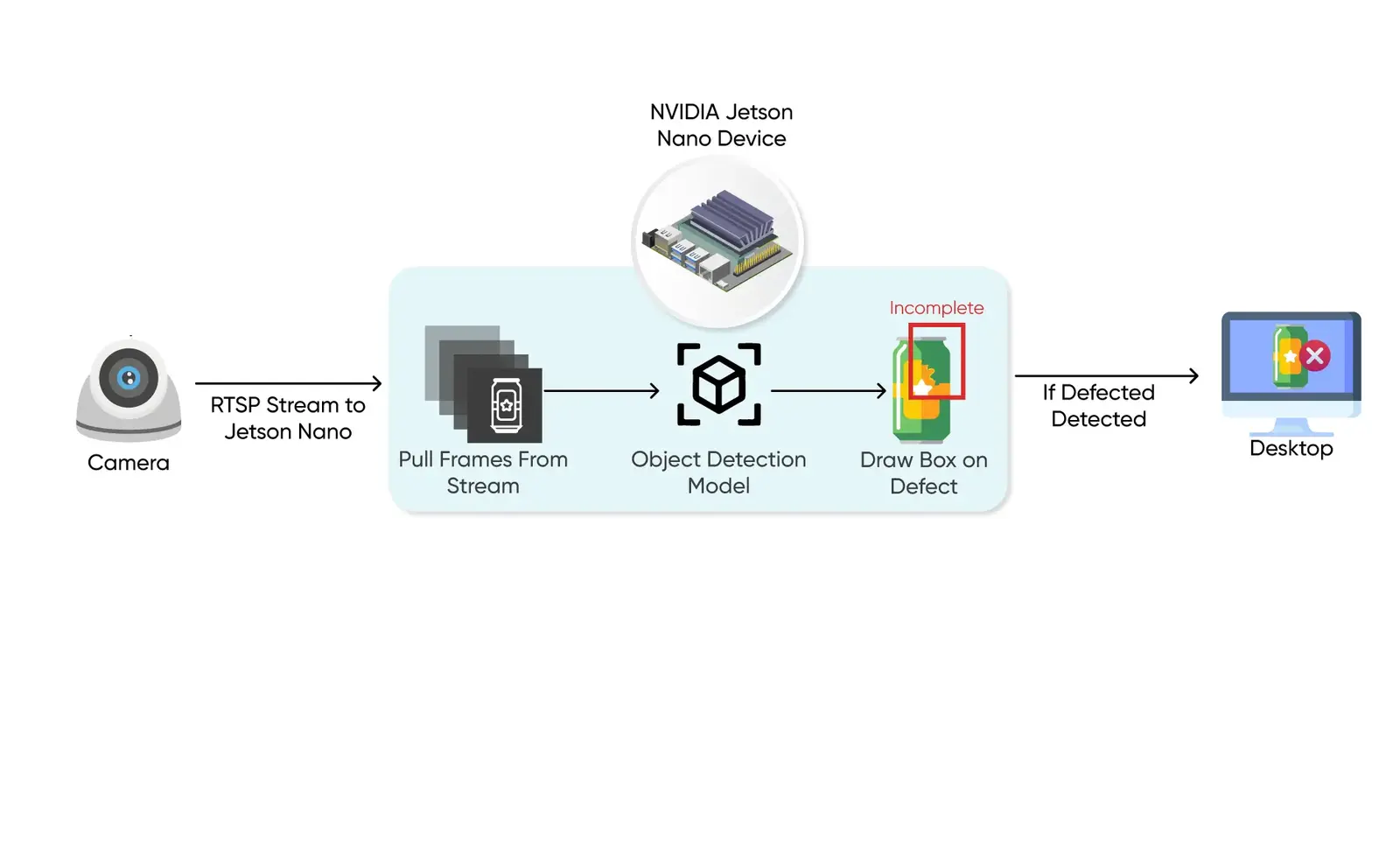
Edge AI and Cloud AI each have distinct advantages for computer vision workloads. Edge AI runs inference on local devices (cameras, sensors, gateways) providing ultra‑low latency, offline operation, and data privacy by keeping sensitive imagery on‑site. It saves bandwidth (only metadata or alerts are sent) and can reduce recurring cloud fees. This makes edge ideal for real-time, privacy‑sensitive or connectivity‐constrained scenarios (e.g. autonomous vehicles, robots, medical devices, smart retail shelves). Cloud AI leverages vast centralized compute and storage. It excels at large‑scale training, global analytics, and elastic scalability. Cloud offerings (e.g. AWS/GCP/Azure Vision APIs, SageMaker, Vertex AI) provide ready‑made models and managed MLOps, simplifying deployment across many locations. Cloud is a natural choice when high throughput, heavy compute (e.g. generative models, 3D reconstruction) or centralized data aggregation is needed.
In practice, most systems use a hybrid approach: edge devices perform immediate inferences, and send aggregated insights or retraining data to the cloud. For example, smart city traffic cameras can do on‑camera vehicle counting, while the cloud optimizes signal timing on historical data. Similarly, retailers may run a local inference engine in each store for shelf detection and send sales summaries to a cloud model that continuously improves recommendations.
Below we compare edge vs cloud across key dimensions (latency, bandwidth, cost, etc.), show architecture patterns (with a Mermaid diagram), and discuss real case studies in retail, manufacturing, smart cities, autonomous vehicles/drones, and healthcare. We provide a decision framework and checklist for choosing edge, cloud or hybrid, a comparison table of popular edge hardware and cloud services, and practical guidance on deployment (CI/CD, monitoring, security, cost modeling). We also outline performance metrics and pitfalls (model drift, security risks) with mitigation strategies. Our aim is a technically accurate, implementation‑aware guide for both engineers and executives.
Edge AI vs Cloud AI: Definitions and Overview
-
Edge AI means running AI (especially inference) on local hardware – smart cameras, gateways, embedded CPUs/NPUs/TPUs – close to where data is generated. Models may be trained in the cloud but inference happens “at the edge”, often offline or with intermittent connectivity. By processing images locally, edge AI yields real-time insights and keeps raw data on-device. Edge hardware ranges from tiny microcontrollers (TinyML) to powerful modules (NVIDIA Jetson, Google Coral, FPGAs, Intel Movidius, etc.).
-
Cloud AI uses remote servers/data centers for both training and inference. Camera streams or batch images are sent over the network to cloud APIs or clusters, where they are processed using GPUs/TPUs and large models. Cloud AI benefits from virtually unlimited compute and storage. It supports complex analytics, retraining on big data, and centralized model management. However, it incurs higher latency and bandwidth use because of data transfer.
Both paradigms are complementary. Data scientists often train vision models in the cloud on large datasets, then deploy optimized versions (quantized/compiled) to edge devices for fast inference. Hybrid architectures combine them: edge devices handle time‑critical inference, and feed sanitized results upstream; the cloud performs heavy analytics, retrains models, and orchestrates updates.
Market context: The global edge AI market is booming (projected ~$270B by 2032), fueled by IoT/5G. Cloud AI (via hyperscale providers) likewise grows rapidly. Many enterprises plan hybrid deployments; e.g. a recent survey cites 78% of retailers aiming for combined edge/cloud systems by 2026.
Key Technical Tradeoffs
Why does Edge AI have lower latency than Cloud AI for computer vision?
Latency path: edge vs. cloud
Edge processing: 10-50ms
Cloud processing: 200ms - 2s+
Edge AI eliminates network hops by running inference directly on local hardware (e.g., NPUs/TPUs), reducing latency to 10–50ms, compared to cloud round-trips which average 200ms to 2 seconds. For safety-critical or interactive systems (autonomous vehicles, drones, AR/VR, robotics, industrial controls), this delay may be unacceptable. According to NVIDIA's developer guidelines, edge sensors in retail loss-prevention or factory lines require real-time alerts under 50ms and cannot tolerate WAN-dependent latencies.
Cloud AI incurs additional network latency. In practice, cloud inference ranges from ~200ms up to 1–2 seconds including data upload. Latency variability is also an issue: network congestion or geographic distance can introduce jitter in response time. This unpredictability can compound under load.
Edge/Cloud Hybrid: A common pattern is to do initial inference on-edge for speed, and send only metadata or critical frames to the cloud for further analysis. This yields the best of both: e.g., an edge camera immediately flags an anomaly locally, then sends metadata to the cloud where a larger model refines decisions on a longer timeframe (see architecture diagram below).
"Processing data at the edge shifts the bottleneck from network throughput to local silicon efficiency, which is essential for scaling high-frequency visual inspection." — Naeem Maqsood, CTO at AxcelerateAI.
How does Edge AI reduce video bandwidth usage?
By processing raw video feeds locally, Edge AI only transmits metadata or alerts to the cloud, reducing upstream bandwidth consumption by 50% to 95% (Source: ResearchGate/Milvus Edge AI studies). Instead of streaming full-resolution video continuously, edge devices send only the results (labels, bounding boxes, aggregated counts). In computer vision use-cases, raw 4K video is highly bandwidth-intensive; local processing removes this bottleneck.
| Stream Type | Upstream Bandwidth | Monthly Data Sent | Est. Egress Fees (Cloud) | Reference / Source |
|---|---|---|---|---|
| Raw 1080p Stream (15 FPS) | ~3.0 Mbps | 972 GB / camera | ~$77.76 / camera / month | AWS Data Transfer egress rates |
| Edge Metadata Only | ~0.05 Mbps | 16 GB / camera | ~$1.28 / camera / month | Standard JSON payload |
Cloud AI requires moving large amounts of data. Transmitting continuous high-res streams to cloud storage hits network caps and incurs substantial cloud egress fees. For instance, streaming video to cloud storage can cost thousands of dollars per camera annually, limiting the feasibility of cloud-only high-frequency vision at scale.
Tradeoff: If network is abundant (e.g., campus LAN or fiber-fed datacenter cameras), cloud analytics at scale is feasible. But in bandwidth-constrained scenarios (remote sites, cellular connectivity, multiple cameras), edge pre-filtering is vital. Edge devices can batch or compress summaries, or employ dynamic sampling. 5G/6G and new protocols (MQTT, gRPC) help, but physics and egress costs ultimately limit cloud throughput.
Compute & Scalability
Cloud AI excels at raw compute. Massive GPU/TPU clusters allow training complex deep networks (CNNs, transformers, RL) on petabytes of images. Cloud instances are elastic: you can spin up more resources as needed. This makes cloud ideal for data-heavy phases (training, batch inference, model evaluation) and global service APIs.
Edge AI is limited by device hardware. Even the most powerful edge modules (Jetson AGX, Intel Movidius, Google Coral, Qualcomm DSPs) offer only a few TOPS (trillions of ops/s) at modest power. They can run many real-time inferences per second, but cannot match datacenter racks. So edge is best for relatively lightweight or optimized models (MobileNet, YOLOv8-Tiny, TensorRT-optimized nets) and lower batch sizes. Running dozens of video feeds on a single edge node is harder without specialized multi-FPGA boards.
For vertical scaling (more cameras/devices), cloud wins: adding devices means slightly more API load, but the cloud backend can autoscale. Edge scaling often means buying and installing more hardware. However, cloud scale has hidden costs (per-inference billing, managing thousands of devices). In practice, many organizations push compute to the edge to avoid cloud scaling costs.
Cost Model
Computer vision cost efficiency
Edge AI typically has high upfront/CapEx (buying devices, sensors, batteries, installation). After that, per‑inference cost is negligible (no recurring inference fees). For large-scale long-term deployments, edge’s fixed cost can be cheaper. Clarifai notes edge can reduce cloud inference bills by 30–40%. However, planning/design costs, maintenance and occasional hardware refresh must be budgeted.
Cloud AI is OpEx/pay-as-you-go. There’s minimal hardware purchase, but fees accrue per request, per GPU-hour, or per storage/egress. For sporadic or low-volume tasks, cloud may be cheaper (no idle hardware). But at scale, “pay-per-inference” can be expensive. CamThink’s TCO analysis shows that with high-frequency vision (10+ captures/day, 100+ cameras), API fees dominate, making edge total cost lower after 1–2 years. Additionally, data egress and storage costs can surprise teams.
In summary:
- Use cloud AI for flexible scaling, development speed and avoiding hardware CapEx. Good for startups/PoCs or variable workloads.
- Use edge AI for predictable budgets, long deployments, and high-volume inferences where recurring fees would explode.
Data Privacy & Security
Edge AI keeps raw data local, which enhances privacy and data residency. Sensitive images (faces, license plates, medical scans) need not traverse the internet. This can ease compliance with GDPR, HIPAA and sector regulations. Many healthcare and finance firms choose edge specifically for security. Additionally, processing locally reduces the attack surface of cloud access keys or exposed APIs. On-device encryption and secure boot can further harden an edge node.
Cloud AI requires sending data over networks. Even encrypted transit introduces risk (man-in-the-middle, misconfiguration). Once in the cloud, data is subject to the CSP’s security model (but providers have strong controls). Enterprises must often perform audits (3–6 months) before trusting a cloud image service. However, CSPs offer certifications (ISO, SOC, FedRAMP) and built-in security tools (IAM, KMS) that small teams may not replicate on-premises.
Edge Risk: Physically deployed cameras/nodes can be stolen or tampered with. This necessitates hardware hardening (TPM, write-only storage, secure APIs). Also, compromised edge models (adversarial attacks) can mis-detect; defense requires techniques like model monitoring or run-time checks.
Cloud Risk: Centralization means a cloud outage or API vulnerability could affect all sites. DDoS attacks on connectivity can disconnect clients. Also, reliance on one vendor may raise IP lock‑in concerns.
Model Deployment & Updates
Edge AI updates are logistically challenging: pushing new models or code to hundreds/thousands of devices requires orchestration (OTA updates) and careful rollout. Version drift or inconsistent firmware can occur if not managed. MLOps for edge typically uses a centralized model registry (e.g. MLflow, S3) and CI/CD pipelines that package models in containers or firmware images. Strategies include staged rollouts, canary tests, and the ability to rollback on failure. Containerization (Kubernetes/K3s, Docker) and edge‑orchestration tools (AWS IoT Greengrass, Azure IoT Edge, KubeEdge) help automate this process.
Cloud AI simplifies updates: deploy a new model once and it serves all clients immediately. A/B testing of models is also easier (multiple endpoints can run different versions). For hybrid systems, updates may go to cloud logic first, then trickle to edge devices as needed. Model telemetry and monitoring should be centralized: track edge inference accuracy, drift, and triggers to retrain. Tools like Prometheus/Grafana can scrape edge metrics (latency, throughput, error counts).
Hardware Constraints & Power
Edge devices range from tiny MCUs (few TOPS, mW power) to robust modules (20+W). Physical size, thermal limits, and battery life dictate choices. For example, Jetson Xavier NX delivers ~14–21 TOPS at 10–15 W, while Google’s Coral TPU runs a model at ~2 TOPS but uses ~2W. Choice depends on workload: battery‑powered drones need sub-5W chips; rack-mounted appliances can use 50W accelerators.
Cloud has no strict hardware limits (you pay for GPUs as needed). However, cloud usage still incurs energy cost (passed to you). For green/remote sites, edge’s ability to run on solar/batteries is a win.
Reliability & Availability
Edge: Can operate offline or in lossy networks. If connectivity drops, edge inference and even buffering of results can continue. However, edge devices must be ruggedized, and hardware failure requires replacement on-site. Achieving “always-on” often means adding redundancy (dual cameras or failover systems).
Cloud: Offers high availability (99.9%+) via redundant data centers. If a cloud service fails, you can switch regions. But outages (or network blackouts) immediately halt vision capabilities at the edge unless there’s an offline backup. Mission‑critical systems sometimes combine both: critical inference local, optional analytics cloud.
Maintainability & Observability
Maintaining an edge fleet is harder: teams need device monitoring (health checks, logs) often via central dashboards. Observability tools (e.g. Prometheus, Datadog IoT) must cover remote networks. Firmware management, remote debugging, and SLA tracking across devices become part of operations.
Cloud-based ML has built‑in monitoring: e.g. AWS CloudWatch, GCP Stackdriver can log model latencies and throughput globally. Version control and reproducibility (via Model Registries, Docker images) tends to be easier in cloud-centric CI/CD.
Regulatory & Compliance
Some data (e.g. medical images, government CCTV) may legally be required to stay in-country or on-premise. Edge AI inherently keeps data local, simplifying compliance with data residency laws. Even GDPR requires special handling for biometric images. Cloud providers do have multi-region storage and encryption, but “air-gapped” edge processing often avoids lengthy legal reviews.
In regulated industries (healthcare, finance, defense), edge solutions often undergo stricter certification (FIPS-certified modules, managed keys). Cloud AI offerings have compliance certifications that can accelerate approvals once data flows are permitted.
Architecture Patterns
A typical hybrid vision AI architecture combines Edge devices (cameras with local inference) and a Cloud backend (for orchestration, analytics, training) as shown below. Edge devices capture images and run a pre-trained model (e.g. object detector) locally. When an event of interest occurs, the device publishes a lightweight message (label, confidence, timestamp) via protocols like MQTT or HTTP to the cloud. The cloud collects these signals (and optionally sample images) into a centralized datastore and triggers further ML processing (video analytics, retraining). New model updates or configuration can be pushed back to edge devices via cloud IoT services. For time-critical control (e.g. automated braking), the edge decision is acted on immediately without waiting for the cloud.
Hybrid edge + cloud architecture
- Camera
- Edge AI Device (NPU/TPU/Module)
- MQTT/HTTP Gateway
- Cloud AI/Analytics
- Central Data Store
- Immediate Action (alarm, stop, alert)
Local inference
Edge AI device → immediate action, without a round trip to the cloud.
This diagram illustrates one pattern: the edge processes frames to make instant decisions, and the cloud handles aggregation, retraining, and system-wide insights. Variations include:
- All-Edge: Devices report only critical metrics (e.g. count or anomaly flag) to a local on-prem server, with no public cloud involvement. (Used when data must stay on-prem.)
- All-Cloud: Cameras stream raw/video to an on-site server or cloud, which does all inference. (Rarely used for real-time vision due to latency; common in batch analytics.)
- Fog/Hierarchical: Edge devices send data to a nearby “fog” gateway (e.g. on-prem server) for additional processing, which then syncs with cloud. This balances local speed with some centralized compute.
Selecting an architecture depends on use-case constraints (see Case Studies below).
Case Studies: Domains and Approaches
-
Retail (Store Analytics & Checkout): Retailers use vision for smart shelves (stock levels) and checkout. Edge AI Example: Cameras above shelves run on-device models to detect low-stock or misplaced items in real-time. Alerts (e.g. “restock item #123”) are sent to the cloud/ERP, minimizing on-site review. Contactless checkout uses local inference to recognize products in a cart, instantly totaling sales at the kiosk; inventory databases in the cloud are updated asynchronously. Recommended Approach: Mostly edge, to track foot traffic and shelf events with minimal latency and privacy issues. The cloud aggregates data across stores to refine merchandising (as in Clarifai’s example of a “massive recommendation engine” in the cloud distributing models to each store). Hybrid works: edge for capture, cloud for analysis.
-
Manufacturing (Quality Control): In factories, cameras inspect products on conveyor belts for defects or misalignment. Edge AI Example: Machine vision cameras with onboard accelerators (NVIDIA Jetson or Intel Movidius) run defect-detection models at line speed (e.g. 30+ FPS). This triggers instant reject or sorting decisions. The cloud can collect aggregated QC statistics, retrain models on new defect types, and optimize throughput. Case: Ultralytics cites surgical tool production requiring high precision; vision AI on the line catches anomalies instantly. Recommended Approach: Edge for inference (to not slow the belt) plus cloud for analytics. Low latency is critical (stalling a line is costly), so local inference is mandated. The cloud side handles logging, model evolution and maintenance. For an in-depth analysis of enterprise database constraints and local vs cloud servers, see our Enterprise Guide on On-Premises vs Cloud CV Deployments.
-
Autonomous Vehicles & Drones: These are inherently edge-centric: self-driving cars and UAVs process camera/LIDAR data on-board with GPUs/NPUs, as connectivity cannot be assumed. Example: An autonomous drone counts people in a disaster site using an on-board vision model. Decisions (e.g. avoid obstacle) must be made in <50 ms, impossible via round-trip to cloud. Fleet management often uses the cloud: vehicles periodically upload telemetry so that central fleets can update navigation or analytics models. Recommended Approach: Edge only for real-time perception and control. Use cloud only for over-the-air (OTA) model refreshes and fleet learning, not for individual trips.
Industry deployment preferences
Autonomous Vehicles
- Edge:
- Real-time Perception
- Cloud:
- Fleet Learning & Data
Smart Cities
- Edge:
- Traffic Counting
- Cloud:
- Signal Optimization
Healthcare
- Edge:
- Robotic Surgery
- Cloud:
- Drug Discovery (Offline)
Retail
- Edge:
- Loss Prevention
- Cloud:
- Recommendation Engines
-
Smart Cities & Infrastructure: City deployments often mix edge and cloud. Example (Traffic Management): Street cameras count vehicles/pedestrians with on-device CNNs. If an incident (crash, traffic jam) is detected, a local edge node raises an immediate alert. Meanwhile, counts from all cameras are sent to a city cloud dashboard. The cloud uses historical data + weather to optimize traffic light schedules. Another example is public safety: for real-time gunshot or fight detection in public spaces, edge AI triggers police alerts in milliseconds, and only metadata (time, location) flows to the cloud. Recommended Approach: Edge for first-mile processing (privacy, low latency, less bandwidth) combined with cloud for city-wide coordination (big data analytics, planning). AI-enabled drone cameras process visual feeds locally, which is crucial for Automated Property Inspections.
-
Healthcare (Medical Imaging, Robotics): Healthcare demands both speed and privacy. Example (Surgery): Advantech’s case study describes an “AI-powered neurosurgery robot” that requires zero latency computing at the operating table. Here, an edge server next to the OR processes imaging and drives robot arms. Patient data never leaves the hospital network. Another Example (Diagnostics): An AI-enabled endoscope runs detection models locally to highlight suspect tissue in real time. Hospitals often restrict patient imagery from cloud upload, so edge computing dominates. Cloud (or private data centers) are used for offline tasks (model training on large medical image datasets, drug discovery). Recommended Approach: Edge for clinical devices, to ensure patient data privacy and real-time feedback. Use the cloud only where data-sharing policies permit (e.g. anonymized data analysis).
-
Agriculture: (Bonus) For completeness, farm sensors/drones process crop images on the field. Predicting irrigation needs or pest presence in real time can be done on-device, since connectivity may be intermittent. Collected data syncs to the cloud for farm-level optimization. (Edge for in-situ alerts, cloud for long-term yield analysis).
Each case highlights that if latency, connectivity or privacy are critical, the edge is preferred; if scale, historical insight or heavy compute is needed, the cloud is used. Often a hybrid yields the best ROI.
Decision Framework / Checklist
To decide between edge, cloud or hybrid, try our interactive tool below:
Edge, cloud or hybrid? Answer four questions
- Step 1: Latency
- Step 2: Connectivity
- Step 3: Data Privacy
- Step 4: Compute Volume
Does your application require sub-100ms response times?
Critical for autonomous systems, robotics, or instant safety alerts.
Ask yourself:
- Latency requirement: Do responses need to happen <100 ms? (e.g. collision avoidance, safety alerts) → Edge AI. If delays of 0.5–2 s are tolerable (e.g. back-office analytics) → Cloud AI is acceptable.
- Connectivity: Is reliable network available? If no (remote site, mobile, low bandwidth), lean Edge (can operate offline). If yes and continuous (e.g. wired LAN, 5G), Cloud can be feasible.
- Data sensitivity: Are there strict privacy/regulations? If yes (HIPAA, GDPR, CCPA), prefer Edge to avoid transmitting raw images. If data is uncritical, Cloud works.
- Compute intensity: Are ML models extremely large/complex? Does project need frequent retraining on huge datasets? If yes, Cloud simplifies training/updating. Edge inference models should be lightweight (quantized) or risk running out of resources.
- Scale & cost: Will you have many devices or high query volume? Calculate TCO: if per-inference fees (cloud) exceed hardware costs over time, Edge likely wins. For pilot/low-volume, Cloud (Opex) lowers entry cost.
- Power/Environment: Are devices battery-powered or outdoors? If yes, you may need ultra-low-power NPUs and edge deployment, since continuous streaming plus full-cloud processing is impractical.
- Update & Maintenance: Can you manage a fleet of devices? If deployment is small/simple, Edge won’t strain ops. If you lack MLOps capability, Cloud (managed endpoints) simplifies updates. Hybrid requires both skill sets.
- Existing infrastructure: Do you already have cameras or IoT networks in place? If repurposing existing IP cams, you might start with cloud APIs to save hardware investment, then gradually introduce smart edge cameras as needed.
- Use-case archetype: Industry patterns matter. E.g. autonomous vehicles, smart cameras, robotics → Edge. Centralized analytics (e.g. market basket analysis) → Cloud. Refer to decision trees like CamThink’s: it suggests edge for outdoor, battery, high-frequency or privacy scenarios, and cloud for indoor, mains-powered, infrequent capture.
This leads to a simple checklist flow:
- If ANY of (strict latency, poor connectivity, privacy constraints, high inference volume) → lean Edge/Hybrid.
- Else if (massive data analytics, periodic training, many non-real-time tasks) → Cloud/Hybrid.
In many projects, the answer is hybrid: split the pipeline so each environment handles what it does best. For instance, use edge devices for immediate classification, and feed anonymized results to the cloud for aggregation and re-training.
Edge & Cloud Platforms: Hardware and Services
| Category | Examples (Vendors) | Pros | Cons |
|---|---|---|---|
| Edge Device (GPU/SoC) | NVIDIA Jetson Xavier/Orin, Apple Neural Engine, AMD Ryzen V (on-prem server GPU) | High compute; flexible (runs full frameworks); mature ecosystem (CUDA, TensorRT) | Higher power and cost; may need cooling; longer lead time for new chips |
| Edge Device (NPU/ASIC) | Google Coral Edge TPU, Intel Movidius, Hailo-8, Kneron | Very low power consumption (1–5W); cost-effective per TOPS; built for CV (e.g. INT8 models) | Limited precision (8-bit); fixed operation support; smaller model memory; vendor lock-in on silicon |
| FPGA/Hybrid Boards | Xilinx Kria/Versal, Intel Agilex, proprietary cards | Ultra-efficient; can run multiple models in parallel; reconfigurable pipelines | Complex to develop (HDL or high-level code); longer time to deploy; lower-level toolchains |
| Microcontrollers | STM32 with ML, ESP32-CAM (TinyML) | Very low cost; lowest power; ideal for trivial tasks (sensor triggers) | Extremely limited compute/memory; only tiny models (keyword spotting, basic CV) |
| Cloud AI Service (Vision API) | AWS Rekognition, Azure Computer Vision, Google Cloud Vision, IBM Watson Visual Recognition | Easy to use APIs; auto-managed scaling; can identify thousands of categories; no infra to manage | Variable latency (network call); per-call fees can be high; limited to vendor’s pre-trained classes or requires cloud-specific training |
| Cloud AI Platform | AWS SageMaker, Azure ML, Google Vertex AI (Vision and AutoML) | Full ML stack (training + inference); integrates data lakes; pay-per-use compute and storage | Ongoing costs (CPU/GPU hours, storage) add up; data transfer costs; vendor lock-in on tooling |
| Edge AI Platform/OS | AWS IoT Greengrass, Azure IoT Edge, Google IoT Edge, KubeEdge | Manages fleet of edge devices; handles messaging, model deployment; integrates with cloud services | Additional complexity; learning curve; some require cloud vendor ecosystem |
| MLOps & Management | MLflow/DVC (registries), Argo/Kubeflow Pipelines, GitLab-CI, Jenkins X | Versioning, CI/CD, can automate edge and cloud deployments | Operational overhead; need infra to run the pipeline; setup costs, learning curve |
| Security Tools | Azure Sphere (secure MCU), AWS IoT Device Defender | Hardware-rooted identity and attestation; anomaly detection; firewalling | Typically platform-specific; may constrain dev environment if locked down |
The table contrasts typical hardware and services. For edge hardware, NVIDIA Jetson boards (Xavier, Orin) provide tens of TOPS with CUDA support, but draw 10–30W. Coral TPUs or Movidius are only a few TOPS but use <5W. For cloud platforms, AWS/GCP/Azure each offer broad vision solutions; they differ slightly in pricing and available models, but all provide GPU/TPU horsepower and MLOps tooling (SageMaker vs Vertex AI). Hybrid platforms (Greengrass, IoT Edge) let you run Lambda-like functions or containers on edge devices that seamlessly communicate with cloud AI services.
(Selection guidance: Jetson/FPGA for heavy processing; Coral/Movidius for power-sensitive inference; Vision APIs for quick deployment without custom models; MLflow/KubeFlow when you need repeatable pipelines.)
Deployment & Operations
CI/CD and Model Rollout: Implement continuous integration pipelines for your models and code. When new labeled data arrives or model accuracy drops, retraining should be automatic (with human review checkpoints). Approved models get version-tagged (e.g. MLflow or DVC registry) and packaged (Docker or firmware). Use tools like Jenkins, GitLab CI/CD, or cloud pipelines to test models (unit tests, validation metrics) and push to staging. For edge devices, over-the-air (OTA) update mechanisms (e.g. Mender, Yocto SWUpdate, or cloud IoT connectors) are vital. Practices include canary deployments (update 5% of devices first), A/B testing different model versions, and quick rollback if error thresholds are exceeded. Amazon has guides on SageMaker MLOps with blue/green model deployments (multi-variant endpoints) for A/B comparisons.
Monitoring & Observability: Continuously monitor inference performance. Track key metrics: latency per inference, throughput (inferences/sec), CPU/GPU utilization, memory usage, and accuracy metrics (e.g. top-1 error, false positives). Log these at edge and cloud. On-edge, use lightweight agents (Prometheus exporter, Telegraf) to push stats to a central Grafana dashboard. Set alerts for anomalies (e.g. sudden drop in accuracy, spike in inference time). Also monitor system health: device uptime, network connectivity, storage space. Good practice: record a small buffer of raw images or feature histograms when model confidence is low, to analyze edge drift.
A/B Testing & Rollbacks: Before fully switching a model, run it in parallel (shadow mode) and compare results. If the new model’s predictions diverge significantly, either disable it or adjust thresholds. Maintain the ability to quickly revert an edge fleet to a known-good model from your registry.
Security Best Practices: Whether edge or cloud, apply defense-in-depth. Encrypt data at rest and in transit. Use secure boot and signed firmware for edge devices. Restrict services and APIs via firewalls/ACLs. In cloud, isolate VPCs and enforce IAM least privilege. Regularly update OS and libraries to patch vulnerabilities. Use hardware security modules (TPM) on devices. For computer vision specifically, be aware of adversarial attacks: include adversarial training or detection if the domain is high-stakes (e.g. security cameras, drones).
Cost Estimation: For cloud costs, model both compute (e.g. GPU hours, function calls) and data (egress, storage). Tools like AWS Cost Explorer or Google’s cost calculators can project vision workload costs. For edge, account for device amortization, energy, and maintenance labor. The earlier overview table [Overview AI] shows how recurring API fees and data costs can dwarf hardware in high-load cases. Run sample TCO scenarios: e.g. 100 cameras at 10 inferences/day vs 1000/day.
Performance Metrics & Evaluation
When evaluating computer vision systems, use both system metrics and task accuracy metrics:
- Inference latency (ms) – time from frame capture to output. Should be measured both on-device (CPU/GPU time) and end-to-end (including any network hop).
- Throughput (FPS or queries/sec) – how many frames the system can process per second. Determine by batch size and hardware constraints.
- Accuracy/Precision/Recall – for detection/recognition tasks, track the usual ML metrics on labeled validation sets. Watch for edge drift in these over time.
- Resource Utilization – CPU/GPU usage %, memory, and power (Watts) during inference. Tools: nvidia-smi (GPU), top (CPU), power monitors.
- Network usage – bytes transmitted per time interval. Important for budgeting bandwidth.
- Uptime / Failure Rate – track device reliability (mean time between failures) and service availability for cloud components.
Sample metrics to log continuously: avg. latency (p50/p95), model confidence histograms, throughput, missed frames (dropped), bandwidth kB/s, error count per hour.
Compare these metrics against SLAs or requirements. For example, ensure 99% of inferences occur under your latency budget. Plot trends: if latency creeps up, model might be overloaded. If accuracy slowly declines, plan retraining.
Limitations, Risks, and Mitigations
- Model Drift & Data Drift: Edge cameras see changing conditions (lighting, new backgrounds). Models degrade over time. Mitigation: Continuously collect and label data (via human-in-loop or auto-labeling) to retrain models periodically. Use cloud analytics to flag performance drops. Consider federated learning if privacy is needed.
- Hardware Obsolescence: Edge hardware can become outdated. Mitigation: Design with modularity (e.g. use USB accelerators that can be swapped). Plan lifecycle budgeting for refresh every 3–5 years.
- Network Failure: If edge depends on occasional cloud or firmware updates, network blips can stall improvements. Mitigation: Support offline operation by caching updates and allowing devices to run autonomously until next connection.
- Security Threats: Physical access to edge devices might allow tampering or spoofing. Mitigation: Secure enclosures, tamper-evident seals, encrypted storage. On cloud, monitor for abnormal access patterns.
- Privacy Breaches: Misconfiguration could send sensitive data to cloud inadvertently. Mitigation: Audit data flows; anonymize or blur PII on-device before sending.
- Vendor Lock-in: Using proprietary edge stacks or cloud APIs risks future migration pain. Mitigation: Favor standard formats (ONNX, TFLite) and open orchestration (Kubernetes, open-source MLOps) where possible.
Finally, business risks include underestimating integration complexity: managing thousands of IoT devices is non-trivial. Starting with a small proof-of-concept, using managed services (or consulting experts), and gradually scaling can mitigate this.
Executive Recommendations & Next Steps
- Assess Use Cases: Catalog your computer vision use-cases by their critical requirements (latency, connectivity, sensitivity, volume). Use the above checklist to categorize each as edge- or cloud-favoring.
- Prototype Key Scenarios: Build small pilots: e.g. deploy an edge camera with a simple model and measure its latency and accuracy in situ; or test a cloud vision API on sample footage to gauge network impact and cost. Instruments system metrics during pilots (latency, bandwidth, CPU) to validate assumptions.
- Choose Architecture: Based on prototypes, decide on architecture patterns. Likely a hybrid approach: edge for inference, cloud for orchestration. Sketch system diagrams (like above) and plan data flows (what goes from edge to cloud).
- Select Platforms: Pick edge hardware (Jetson, Coral, etc.) that meets your compute/power budget. Choose a cloud provider considering existing ecosystem and AI services (AWS, Azure, GCP). Consider using MLOps tools that can cover both (e.g. Kubernetes, MLflow, or multi-cloud CI/CD). Use the table above as a reference.
- Plan Ops: Set up a model registry and CI/CD pipeline from the start. Automate testing, deployment, and rollback. Integrate monitoring tools for edge devices (Prometheus, cloud dashboards) and define key metrics/KPIs.
- Security & Compliance: Involve security/compliance teams early. For edge devices, ensure firmware signing and encrypted storage. For cloud, evaluate compliance certifications and plan for data encryption.
- Cost Modeling: Run detailed cost comparisons: consider cloud API rates, data egress fees, versus hardware and maintenance costs of edge. Tools like AWS Cost Calculator or custom spreadsheets can help. Don’t forget operational expenses (Wi-Fi/LTE connectivity, electricity, device swaps).
- Documentation & Training: Ensure your engineers understand the hybrid architecture. Document fallback modes, update procedures, and data flows. Provide training on MLOps and IoT management if needed.
By following this rigorous evaluation, you can harness the strengths of both edge and cloud AI for computer vision. Start small, iterate quickly, and build confidence before scaling to thousands of devices. The right balance of edge and cloud will yield a system that is both responsive and scalable, cutting-edge yet practical.
Sources: Authoritative industry blogs, vendor whitepapers, and research reports were used throughout. This report synthesizes these with technical insight for implementers and decision-makers.