Every day, people describe exactly what they want to buy in public. They ask Reddit for a tool recommendation, complain on X about a product that let them down, or ask on LinkedIn whether anyone has solved the problem they are stuck on. Most of those conversations never reach the companies that could help, because nobody at those companies is reading them.
AI social listening is the practice of reading those public conversations at scale and working out which ones matter. It is the layer that sits between "the internet is talking" and "someone on our team should reply to this".
Monitoring versus listening
The two terms get used interchangeably. They describe different jobs.
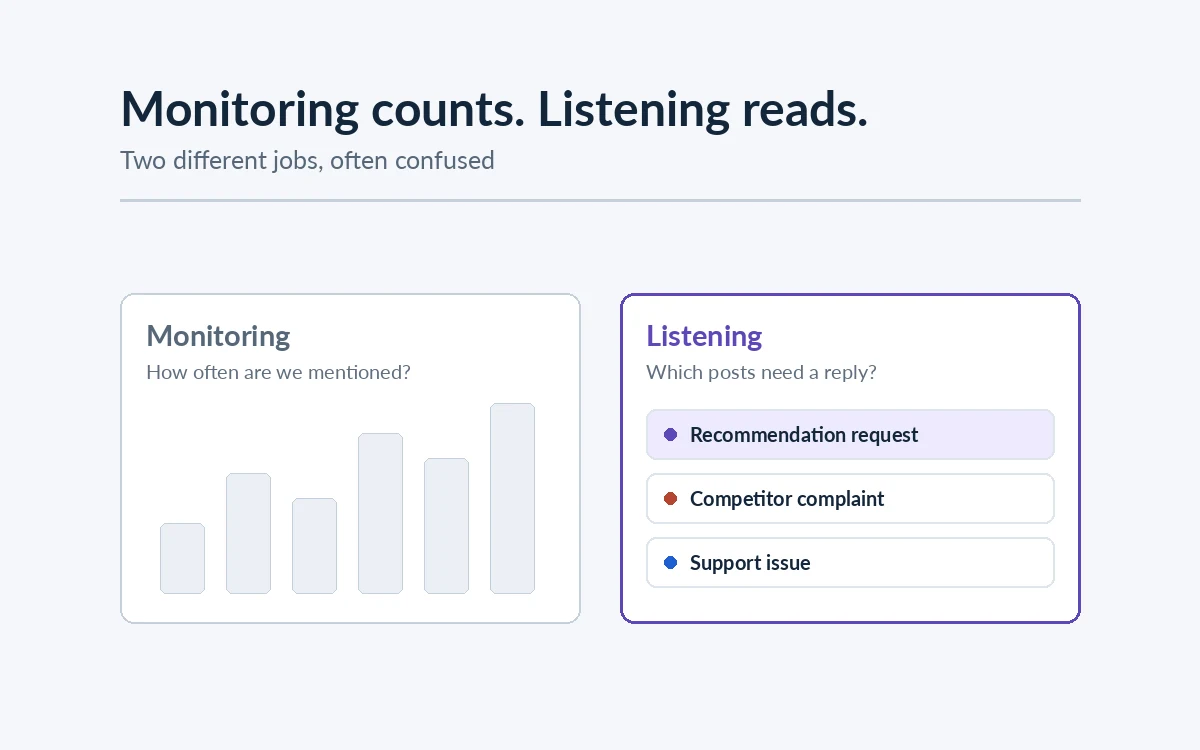
Social monitoring answers how much. It counts mentions of your brand, tracks share of voice against competitors, and charts sentiment over time. It is reporting: useful for a monthly review, and mostly backwards-looking.
Social listening answers what does this mean, and what should we do. It reads each conversation, classifies what the person is trying to do, and decides whether it deserves a response. It is operational: the output is a queue of conversations, not a chart.
| Monitoring | Listening | |
|---|---|---|
| Core question | How often are we mentioned? | Which conversations need a response? |
| Unit of output | Counts, trends, dashboards | Individual conversations, prioritised |
| Time horizon | Last week, last month | Now, while the thread is active |
| Typical owner | Brand or PR reporting | Growth, support, sales |
| Typical action | Adjust strategy | Join the conversation |
Most teams need both. The difference matters because the tools built for monitoring tend to be poor at listening, and the gap is exactly where the value sits.
What changed with AI
Listening used to mean keyword alerts plus a person reading the results. That breaks in two directions at once.
Too much noise. A keyword alert for a product category returns every post containing the word, most of which are jokes, news, unrelated uses of the same term, or people who already bought something. The useful conversations are a small fraction of the feed, and the person reading it gives up.
Too little signal. The most valuable posts frequently do not contain your keywords at all. Someone asking "what do agencies use to chase late invoices?" is a buyer for invoicing software, and never typed the word "invoicing". A keyword list cannot anticipate every way a person describes a problem.
Language models fix both by reading for meaning rather than matching strings. A classifier can label each post as a recommendation request, a competitor complaint, a support question or noise, and score how relevant it is, regardless of the exact words used. We go into why keyword alerts fail in more detail in why keyword alerts miss buying intent.
How an AI listening pipeline works
The pipeline behind a listening system is broadly the same regardless of vendor:
- Define what to listen for. Your brand, your competitors, your product categories, and the long-tail phrases people use to describe the problem you solve, on the platforms where your buyers talk.
- Collect public conversations as they appear, and filter out obvious noise before anything expensive runs on it.
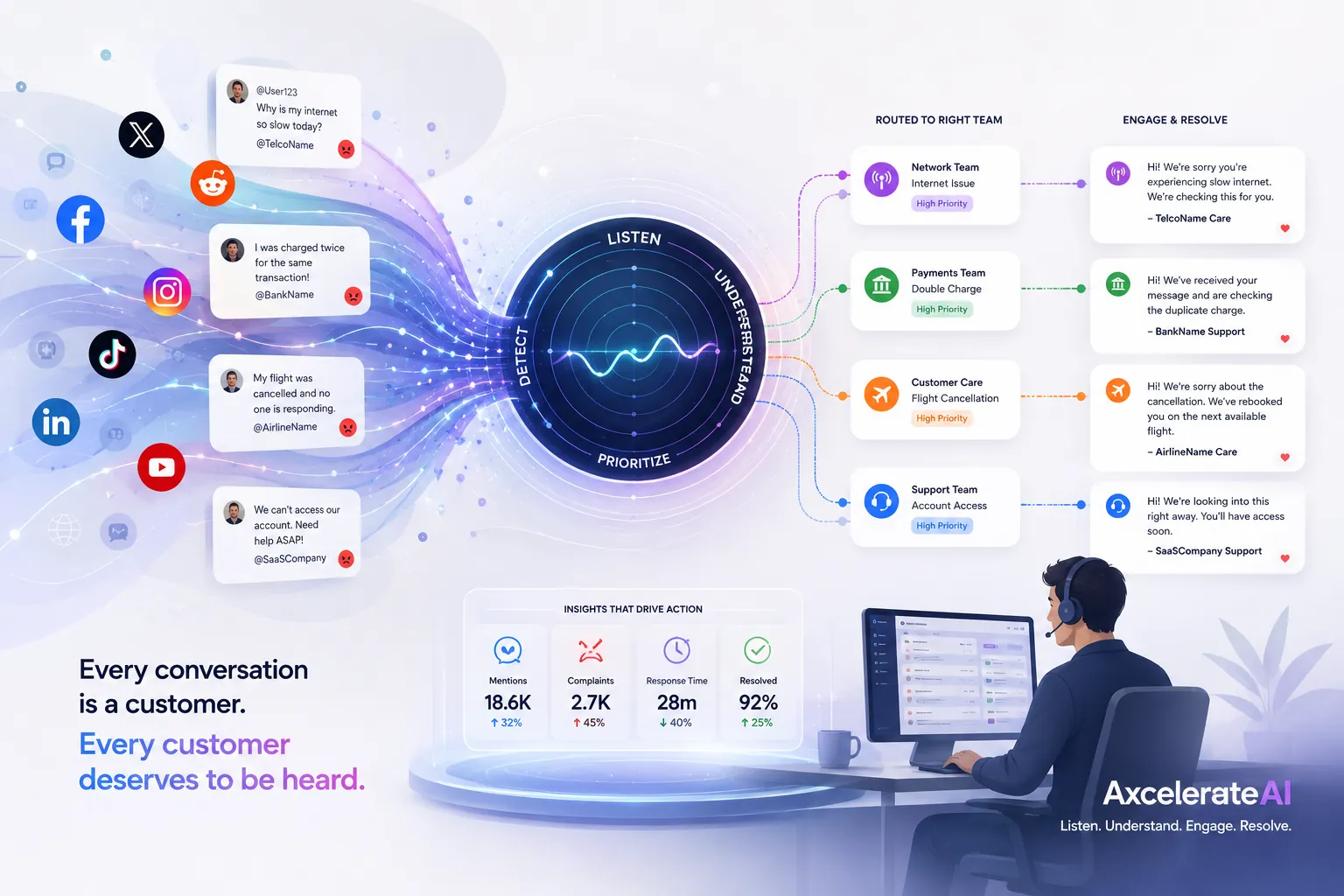
- Classify intent and sentiment. Each post is labelled: buying signal, recommendation request, competitor complaint, question, support issue. Sentiment and a relevance score make prioritising possible.
- Route or respond. High-intent conversations go to the right person, or into a reply workflow.
- Measure. Track which conversations led to traffic, conversations and pipeline, and which topics and competitors come up most.
Step 3 is where AI changed the economics. Steps 1, 2 and 5 existed before; classification at the quality needed to trust it did not.
What teams use it for
The same listening layer serves several teams, which is part of why it pays for itself.
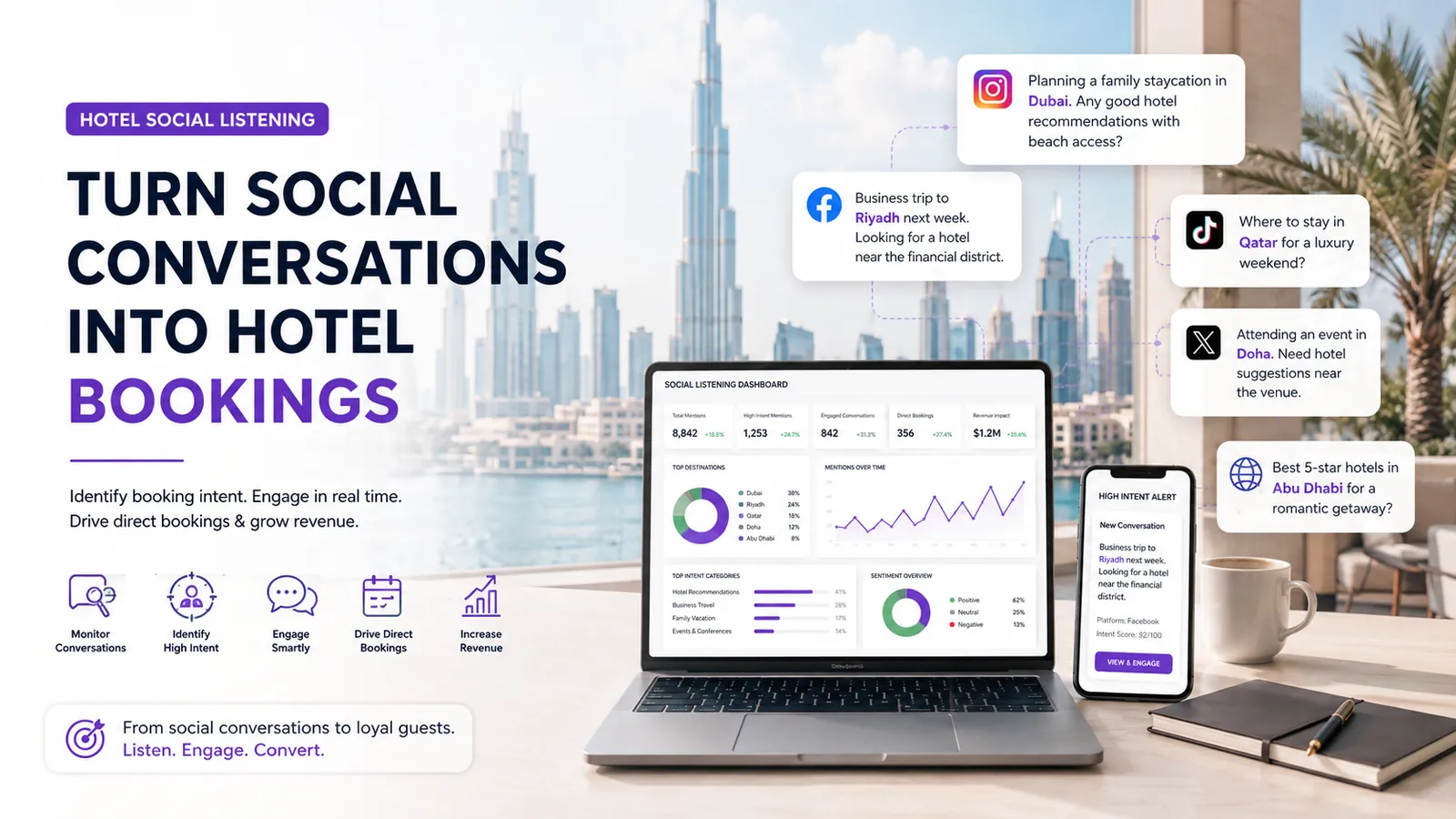
Growth teams and founders use it to find demand before it is obvious: people asking for tools like theirs, and people complaining about the ones they already use. For an early-stage product with no ad budget, this is often the most efficient acquisition channel available.
Marketing uses it as campaign intelligence: what language buyers actually use, which messages land, which content ideas are emerging, and how a launch is being received.
PR and communications use it to catch negative sentiment early, before a slow support thread becomes a reputation problem.
Support uses it to catch customers who complain in public instead of opening a ticket. We cover that workflow in social listening for customer support.
Agencies use it to monitor several client brands through one listening layer, and to surface new client opportunities.
Where listening becomes engagement
Listening tells you which conversations matter. The step after it is replying, and that is where most of the value is captured or lost.
A recommendation request on Reddit has a short life. The thread is active for hours, perhaps a day; after that, the person has chosen something. A listening system that surfaces the post next week has found history, not demand.
That is why listening and engagement increasingly come as one system: classify the post as it arrives, draft a reply in your brand voice, and have your team approve it while the thread is still live. Doing that well, without sounding like a bot or breaking platform rules, is its own discipline, covered in replying to social posts with AI without being spam.
Where to start
You do not need a platform to find out whether listening is worth it for you. Take one week, pick the two platforms where your buyers are most likely to talk, and search manually for the ways people describe the problem you solve. Count how many genuine buying conversations you find, and how many your brand replied to.
If that number is not zero, you are leaving demand on the table. The question then is whether reading those conversations by hand scales, and for most teams it does not.
How AxcelerateAI Helps
AxcelerateAI builds AI social listening and engagement across Reddit, X, LinkedIn, Instagram, Facebook and TikTok:
- Intent classification that labels buying signals, recommendation requests and competitor complaints as they appear.
- Replies drafted in your brand voice, trained on your past interactions, marketing materials and guidelines.
- Human approval or auto-publish, your choice, following each platform's API guidelines and rate limits.
Get a free report of the buying conversations your brand missed.