A growing number of jurisdictions now place limits on where certain categories of data may be stored and processed. For most software this is a hosting decision. For AI systems it is an architecture decision, because an AI pipeline crosses jurisdictional boundaries at several stages, and only one of them is obvious.
This is orientation for a technical conversation, not legal advice. We are AI engineers. Rules change, and how they apply depends on your sector and your data — your counsel establishes what the requirement is, and we build a system that meets it.
First, the distinction that causes the most rework
Data residency is about where data physically sits and is processed. An in-country cloud region satisfies it.
Data sovereignty is about which jurisdiction's laws and authorities can reach the data, and who controls the keys, the models and the operations. An in-country region of a foreign-owned provider satisfies residency but may not satisfy sovereignty, because the question is legal reach rather than physical location.
Teams that treat these as synonyms design for the cheaper one and discover during a security review that they needed the other. Establishing which applies is the first hour of the project, not the last.
Where AI pipelines cross the boundary
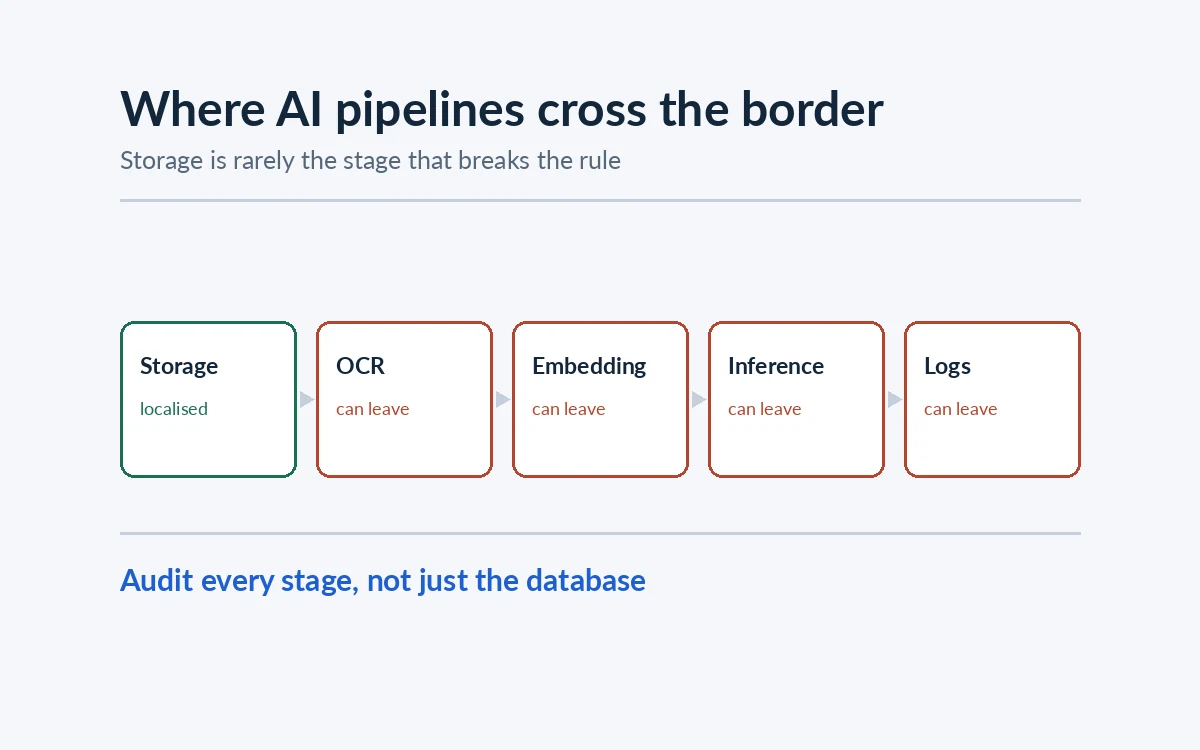
Before the regional detail, the engineering point that matters most: storage is rarely the stage that breaks the rule.
Teams localise the database and consider the matter settled. Meanwhile:
- Embedding. Turning documents into vectors is processing. A hosted embedding API moves every document you index, one by one.
- Inference. The prompt usually contains the sensitive part. A hosted model endpoint moves it on every request.
- OCR and pre-processing. Scanned documents sent to an external OCR service have already left before any model sees them.
- Logs and telemetry. Prompt and response logging shipped to a monitoring service carries the content with it.
- Model updates. Pipelines that fetch weights or contact a licence server at runtime create an outbound path an isolated network cannot permit.
The audit worth running: list every stage between a document arriving and an answer being returned, and for each one ask where it physically executes and what leaves. Running open-weight models on infrastructure you control closes most of these at once.
Region by region
Described in general terms, with commencement dates where a rule has one.
Gulf states
Saudi Arabia's National Data Management Office set out localisation requirements in 2024 under which government and critical-sector data must be stored and processed inside the country. National AI programmes across the region are simultaneously building domestic compute capacity and Arabic-capable models, on the same reasoning: sensitive public-sector workloads should run on models and infrastructure under domestic control.
Architectural consequence: in-country processing for public-sector and critical data, with attention to whether the requirement is about location alone or about operational control as well.
European Union
GDPR governs where and how personal data may be processed and on what basis it may be transferred outside the bloc. The EU AI Act adds obligations for systems classified as high-risk, with that tier's requirements applying from 2 August 2026. Alongside the regulation, substantial public funding and certification frameworks are pushing enterprises toward sovereign infrastructure options.
Architectural consequence: EU-region processing with a documented transfer basis, and for high-risk systems, obligations around documentation, oversight and risk management that shape the system rather than just its hosting.
Southeast Asia
Vietnam's Law on Artificial Intelligence took effect on 1 March 2026, covering risk classification, transparency, incident management and state oversight, and requiring foreign providers to appoint a local legal representative. Indonesia's Personal Data Protection Law governs cross-border transfer through adequacy and contractual routes. Malaysia has funded a national sovereign AI cloud and released a domestically developed model.
Architectural consequence: in-country hosting for named data categories, and in Vietnam, obligations that attach to the provider as well as the deployment.
Africa
South Africa's POPIA restricts transferring personal information abroad unless the recipient offers substantially similar protection, and the National Data and Cloud Policy requires data bearing on national security to sit on infrastructure inside the country. A standalone national AI policy is still being consulted on, so POPIA remains the operative instrument.
Architectural consequence: local processing by default, with cross-border transfer justified case by case rather than assumed.
India
The Digital Personal Data Protection Act sets the framework for personal data handling and cross-border transfer, alongside a national AI mission funding domestic compute and models. Sector regulators layer their own requirements on top, with financial services the most prescriptive.
Architectural consequence: the national framework is the floor; your sector regulator frequently sets the actual requirement.
Constraints that are not regulatory at all
Not every limit comes from a government. Client agreements, NDAs and sector codes routinely prohibit sending data to any third-party service regardless of jurisdiction, and in practice these bind a project as tightly as legislation. They are also easier to overlook, because nobody publishes them.
For teams working under client contracts — agencies, consultancies, contractors — this is frequently the binding constraint, and it points toward on-premises or air-gapped deployment rather than an in-country cloud region.
What this means for architecture
Four patterns cover most requirements, and the choice follows from the constraint rather than from preference:
| Constraint | Usual answer |
|---|---|
| Data must not leave the country | Your own cloud account, in-country region |
| No third-party processing permitted | On-premises, or your own cloud with self-hosted models |
| Foreign legal reach is the concern | Sovereign cloud, or on-premises |
| No outbound network connection | Air-gapped on-premises |
We compare these in detail in air-gapped, private cloud or sovereign cloud.
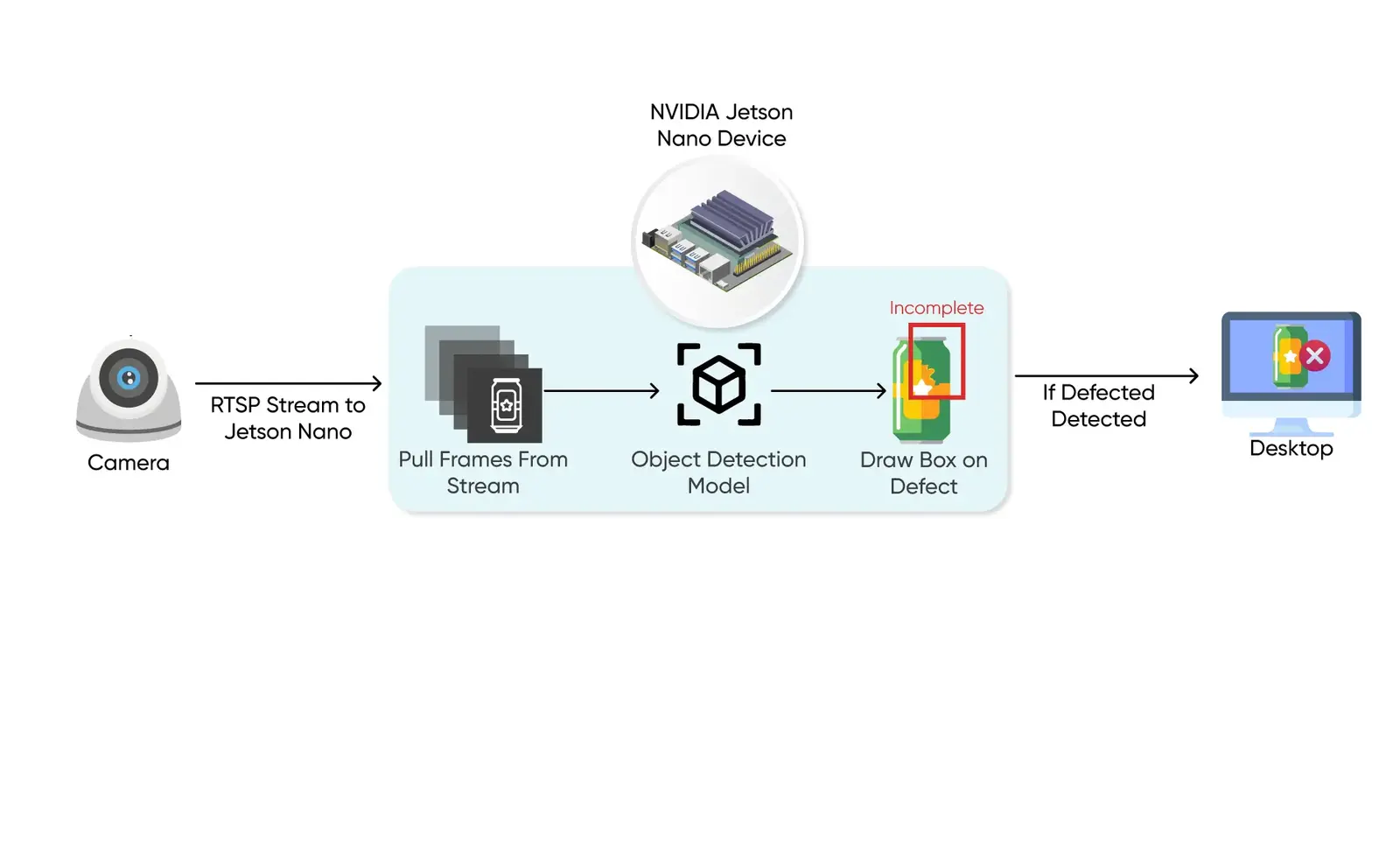
One architecture is worth calling out separately: for video and sensor workloads, processing at the edge means only results travel, never the footage. For camera systems this is frequently the cleanest answer to a residency question, and it reduces bandwidth at the same time.
A checklist before you design anything
- Which rule applies? Established by your counsel, not inferred from a vendor's compliance page.
- Residency or sovereignty? Location, or legal reach and operational control.
- Which data categories? Rules frequently apply to defined categories rather than to everything you hold.
- Every pipeline stage mapped. Storage, embedding, inference, OCR, logging, updates.
- What leaves, and to where? Including telemetry nobody thought to check.
- What does the update path look like? Particularly for isolated networks, where it needs agreeing up front.
Working through this before the architecture is drawn is considerably cheaper than discovering a crossing after deployment.
How AxcelerateAI Helps
We build private AI deployments to whichever environment a project requires, and our published case studies span clients in the United States, the United Kingdom, Cyprus, Australia, New Zealand and South Africa, plus a clinical decision support system for a medical clinic in Riyadh.
- Constraint review first, so the architecture matches the actual requirement.
- Full-pipeline audit, so no stage quietly crosses a boundary.
- Deployment to your nominated environment, on-premises, air-gapped, your own cloud account or a sovereign platform.