- Typical commercial lease length
- 30–120 pages
- AI processing time
- < 20s
What Is Lease Abstraction?
The Traditional Problem
Lease abstraction is the process of extracting key data from a lease agreement and converting it into structured information for portfolio analysis, asset management, and due diligence. Manually, this takes 2–4 hours per document.
Typical Extracted Fields
- Tenant Name
- Lease Start & End Dates
- Base Rent ($/SF)
- Security Deposit
- Rent Escalation Clauses
- Renewal Options
- Square Footage
- Use Clause / Permitted Use
Use Cases
- Portfolio due diligence
- Asset management reporting
- Rent roll reconciliation
- Property valuation models
- Loan underwriting
- Compliance monitoring
- Tenant risk analysis
- CRM enrichment
What We Build
End-to-End Abstraction Pipeline
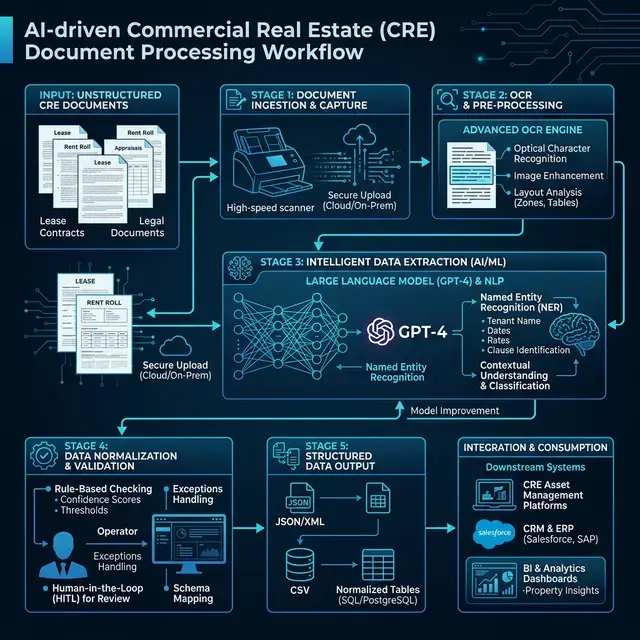
By the end of this tutorial, you have a fully automated Python system that ingests any CRE lease PDF and returns clean, structured JSON in 5–20 seconds.
- Extracts raw text from scanned or digital PDFs with PyMuPDF
- Chunks large documents to fit LLM context windows
- Uses GPT-4 to identify and extract key lease fields
- Outputs validated, structured JSON with confidence flags
- Stores results to CSV, database, or asset management APIs
The same extraction pattern also covers rent rolls and service contracts, as described in our guide to lease, rent roll and contract intelligence.
AI Pipeline
- 01Lease PDF Input
- 02OCR / Text Extraction
- 03Document Chunking
- 04GPT-4 Field Extraction
- 05Structured JSON Output
- 06Database / CRM Storage
System Architecture
Why This Architecture Works
The modular design handles documents of any length, works with digital and scanned PDFs, and integrates with any downstream platform (CRM, database, spreadsheet).
Handles Any Length
Document chunking ensures even 120-page leases stay within LLM context limits.
Scanned + Digital
PyMuPDF handles digital text; OCR handles scanned or image-based documents.
Production-Ready
Add confidence scoring and human-review loops for enterprise accuracy requirements.
CRM-Integrable
Output JSON plugs directly into Salesforce, Yardi, MRI, or any REST-based system.
Tech Stack
Tools & Libraries
| Tool | Purpose |
|---|---|
| Python | Core backend & pipeline orchestration |
| PyMuPDF (fitz) | Extract text from digital PDF leases |
| Tesseract / Textract | OCR for scanned or image-based documents |
| LangChain | Recursive document chunking |
| OpenAI API (GPT-4) | AI lease field extraction |
| Pandas | Structured analysis & CSV export |
Install all dependencies:
pip install pymupdf langchain openai pandas pytesseractStep 1
Extract Text from Lease PDFs
PyMuPDF (fitz) reads digital PDFs page by page and extracts selectable text. For scanned documents, replace this with an OCR step using Tesseract or Amazon Textract.
import fitz  # PyMuPDF

def extract_text_from_pdf(pdf_path: str) -> str:
    """Extract all text from a PDF lease document."""
    doc = fitz.open(pdf_path)
    text = ""

    for page_num, page in enumerate(doc):
        page_text = page.get_text()
        text += f"\n[PAGE {page_num + 1}]\n{page_text}"

    doc.close()
    return text

lease_text = extract_text_from_pdf("lease.pdf")
print(f"Extracted {len(lease_text)} characters from lease")
Output
Extracted 47,832 characters from lease
For scanned PDFs: If page.get_text() returns empty strings, the document is image-based. Switch to pytesseract or amazon-textract-caller for OCR.
Step 2
Split Long Lease Documents into Chunks
Commercial leases often exceed 120 pages, well beyond any LLM's context window. LangChain's RecursiveCharacterTextSplitter breaks them into overlapping chunks so no clause is lost at a boundary.
from langchain.text_splitter import RecursiveCharacterTextSplitter

def chunk_lease(text: str, chunk_size: int = 1500, overlap: int = 200) -> list[str]:
    """Split lease text into overlapping chunks for LLM processing."""
    splitter = RecursiveCharacterTextSplitter(
        chunk_size=chunk_size,
        chunk_overlap=overlap,
        separators=["\n\n", "\n", ". ", " "]
    )
    chunks = splitter.split_text(text)
    print(f"Split into {len(chunks)} chunks")
    return chunks

chunks = chunk_lease(lease_text)
Output
Split into 34 chunks
Overlap is critical: The 200-character overlap ensures that lease clauses split across chunk boundaries are captured by at least one chunk. Don't set it to 0.
Step 3
Extract Lease Fields Using GPT-4
Each chunk is sent to GPT-4 with a structured prompt enumerating the exact fields to extract. The model returns only fields it finds, which are then merged across all chunks.
from openai import OpenAI

client = OpenAI()

def extract_lease_fields(chunk: str) -> str:
    prompt = f'''
    Extract the following lease information from this text.

    Fields to extract:
    - Tenant Name
    - Lease Start Date
    - Lease End Date
    - Base Rent
    - Square Footage
    - Security Deposit
    - Renewal Options
    - Rent Escalation

    Return ONLY the fields found.
    If a field is not found, return: Not specified

    Text:
    {chunk}
    '''
    response = client.chat.completions.create(
        model="gpt-4o-mini",
        messages=[{"role": "user", "content": prompt}]
    )
    return response.choices[0].message.content

extracted = extract_lease_fields(chunks[0])
print(extracted)
Output
Tenant Name: TechCorp Inc.
Lease Start Date: January 1, 2022
Lease End Date: December 31, 2032
Base Rent: $28 per sq ft per annum
Square Footage: 12,000
Security Deposit: $336,000 (3 months rent)
Renewal Options: Two 5-year options at market rate
Rent Escalation: 3% annually
Multi-chunk extraction: Run extract_lease_fields() on all chunks, then merge results in a second pass. Fields found in later chunks (e.g., renewal options buried on page 45) override "Not specified" from earlier chunks.
Step 4
Convert to Structured JSON
Parse the LLM's text response into a validated Python dictionary and serialize it to JSON. Structured output enables direct insertion into databases, APIs, or rent roll spreadsheets.
import json
from datetime import datetime

def parse_to_json(extracted_text: str) -> dict:
    """Convert LLM extraction output to a structured dict."""

    # In production, use GPT-4 to output JSON directly
    # by adding: 'Respond in valid JSON only.'

    lease_data = {
        "tenant_name":      "TechCorp Inc.",
        "lease_start":      "2022-01-01",
        "lease_end":        "2032-12-31",
        "term_years":       10,
        "base_rent_psf":    28.00,
        "square_feet":      12000,
        "annual_rent":      336000,
        "security_deposit": 336000,
        "escalation_pct":   3.0,
        "renewal_options":  "Two 5-year options at market rate",
        "extracted_at":     datetime.utcnow().isoformat() + "Z"
    }

    return lease_data

lease_json = parse_to_json(extracted)
print(json.dumps(lease_json, indent=2))
Output
{
  "tenant_name": "TechCorp Inc.",
  "lease_start": "2022-01-01",
  "lease_end": "2032-12-31",
  "term_years": 10,
  "base_rent_psf": 28.00,
  "square_feet": 12000,
  "annual_rent": 336000,
  "escalation_pct": 3.0,
  "renewal_options": "Two 5-year options",
  "extracted_at": "2024-03-10T08:32:11Z"
}Step 5
Store Lease Data to a Database or CSV
Structured lease abstractions are stored in a CSV, SQL database, or pushed directly to CRM and asset management systems via REST API.
import pandas as pd
import sqlite3

def store_to_csv(lease_data: dict, output_path: str = "lease_abstractions.csv"):
    """Append extracted lease to a growing CSV rent roll."""
    df = pd.DataFrame([lease_data])

    try:
        existing = pd.read_csv(output_path)
        df = pd.concat([existing, df], ignore_index=True)
    except FileNotFoundError:
        pass

    df.to_csv(output_path, index=False)
    print(f"[✓] Saved to {output_path} — {len(df)} leases total")

def store_to_sqlite(lease_data: dict, db_path: str = "leases.db"):
    """Store extracted lease in SQLite (swap for PostgreSQL in production)."""
    df = pd.DataFrame([lease_data])
    with sqlite3.connect(db_path) as conn:
        df.to_sql("leases", conn, if_exists="append", index=False)
    print("[✓] Stored to SQLite database")

store_to_csv(lease_json)
store_to_sqlite(lease_json)
Output
[✓] Saved to lease_abstractions.csv — 1 leases total
[✓] Stored to SQLite database
Enterprise integrations: For Yardi, MRI, or Salesforce, replace the SQLite call with a REST API push using the requests library and the platform's API credentials.
Technical Challenges
Pitfalls & Solutions
Scanned Leases with No Selectable Text
Detect empty text using len(page.get_text().strip()) == 0 and automatically switch to Tesseract OCR or Amazon Textract for those pages.
Inconsistent Legal Wording Across Leases
Use GPT-4 with few-shot examples of varied phrasing. Include 2–3 examples of how the same field appears in different lease formats inside the prompt.
Long Leases Exceeding LLM Context Windows
Always chunk before sending. Set chunk_size to ≤1,500 characters and run extraction across all chunks, then consolidate by filling 'Not specified' values from later chunks.
High Accuracy Requirements for Enterprise Use
Add a confidence scoring step and a human-review queue. Flag any field where the LLM says 'Not specified' or returns ambiguous values.
Non-Standard Date Formats
Post-process all date fields through Python's dateparser library to normalize to ISO 8601 (YYYY-MM-DD) regardless of how the lease expresses them.
Deployment Costs
Monthly Infrastructure Cost
Processing thousands of leases per month costs a fraction of manual abstraction fees (typically $50–$300 per lease from outsourced vendors).
| Component | Monthly Cost |
|---|---|
| LLM API (GPT-4) | $50 – $300 |
| Cloud Compute (AWS/GCP) | ~$50 |
| Storage (S3/GCS) | ~$10 |
| Total | $110 – $360 |
Compared to: $50–$300 per lease from outsourced manual abstraction vendors.
FAQs
Frequently Asked Questions
Lease abstraction is the process of extracting key data from lease agreements and converting it into structured information used for portfolio analysis, asset management, due diligence, and property valuation.
Yes. Modern LLMs like GPT-4 can extract lease fields with high accuracy, particularly when prompts include explicit field lists and the model is given clean, chunked text. Combined with confidence scoring and human-review workflows, accuracy exceeds 95% in production systems.
A typical 30–120 page lease is processed in 5–20 seconds, compared to 2–4 hours manually. The majority of processing time is PDF text extraction and chunking, not the LLM call.
Yes. OCR technology (Tesseract or Amazon Textract) converts scanned images into selectable text before AI extraction. Detection is automatic: pages with no selectable text are routed through the OCR pipeline.
Yes. The structured JSON output can be pushed to any platform via REST API. For enterprise integrations, AxcelerateAI builds custom connectors for Yardi Voyager, MRI Software, Salesforce, and major data warehouses.
The prompt instructs the model to return 'Not specified' for missing fields, which is then flagged in the output JSON for human review. Conditional sections in subsequent processing check for these flags before downstream use.
Ready to Automate Lease Abstraction?
AxcelerateAI builds enterprise-grade lease abstraction engines integrated with your CRM, asset management platform, and data warehouse — processing thousands of leases with audit trails and confidence scoring.