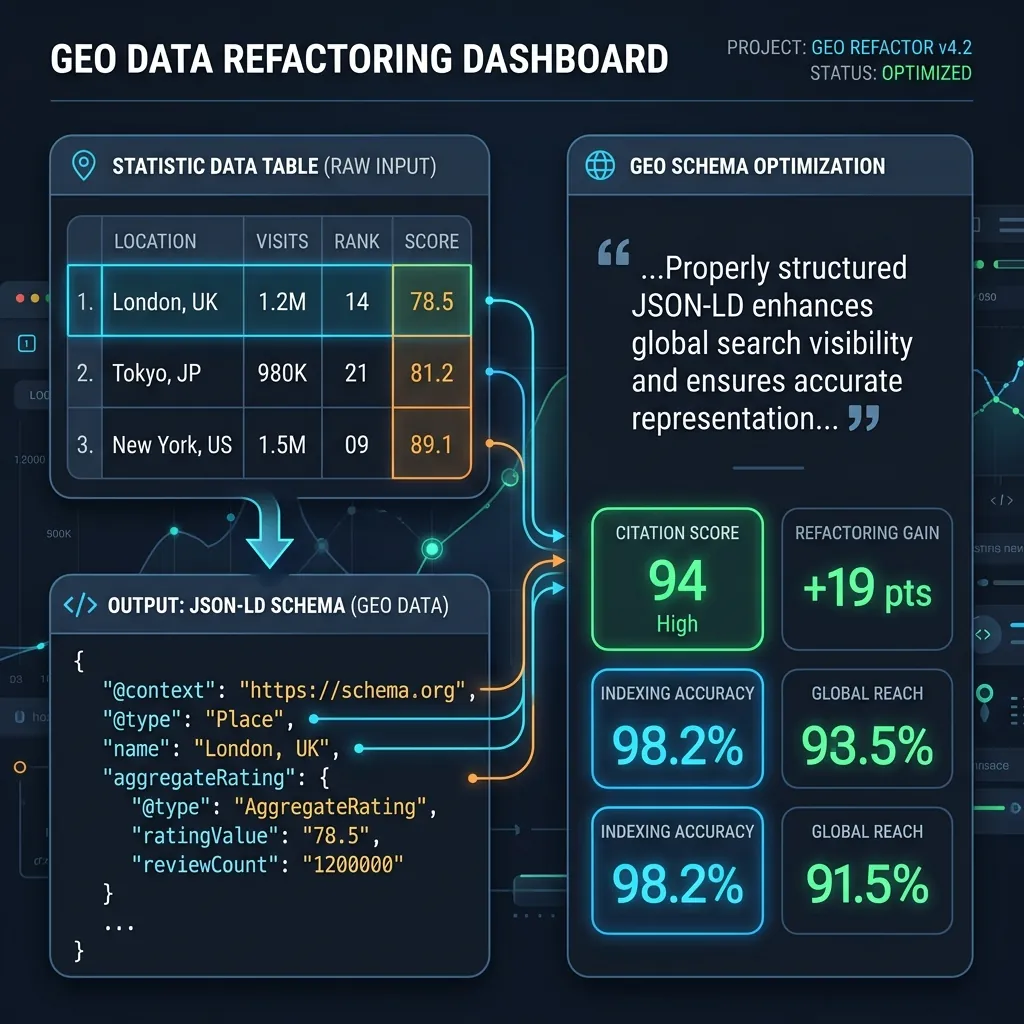
As search engines transform into answering machines, developers and content creators must adapt. Simply ranking in search results is no longer the metric of success. The new frontier is GEO: Generative Engine Optimization.
GEO is the practice of structuring website content and code so conversational AI models (such as ChatGPT, Perplexity, Claude, and Gemini) retrieve, synthesize, and cite your brand as the primary authority.
This handbook outlines the core technical and editorial pillars of GEO, based on the latest research in Large Language Model (LLM) information retrieval.
1. Information Gain: The Anti-Commodity Filter
LLMs are trained on billions of pages of common web data. If your article simply rewrites existing search results, it adds zero value to the model. AI search scrapers filter out redundant content to save context window space.
To rank in LLM answers, your content must offer high Information Gain:
- Proprietary Data: Publish original case studies, surveys, and research findings.
- Unique Perspectives: Detail specific developer workflows, proprietary code integrations, and first-hand engineering guides.
- Zero Placeholders: Avoid generic filler text. LLMs value density of information over word count.
2. Optimizing Quote Density & Expert Authority
Academic and empirical research on generative engines reveals that LLMs prioritize sources that quote authoritative entities.
- Direct Quotes: Incorporate quotes from verified technical architects, industry researchers, or C-level executives.
- Semantic Tagging: Use HTML5
<blockquote font-semibold>tags to outline quotes clearly. - Attribution Mappings: Ensure the quote includes the author's title and credentials, allowing the LLM's entity parser to link their authority to your domain.
3. Statistic Authority & Table Structures
Generative models are mathematically designed to quote statistics to back up claims in synthesized answers.
- Stat Injection: Integrate verified stats into your pages (e.g. "achieving a 250ms image processing speed and reducing underwriting times to under 3 minutes").
- Grid Layouts & Tables: Present stats inside semantic HTML
<table>containers rather than list bullets. LLM parsers ingest tabular data with high structural confidence. - Schema Bindings: Link statistics to schema JSON-LD parameters to define what the number represents (e.g., speed, percentage, dollars).
4. Front-End Technical crawlability
Your content can be highly optimized, but if the AI scraper cannot parse it, you remain invisible.
- Server-Side Rendering (SSR): AI search bots like
OAI-SearchBotoften bypass executing client-side JavaScript to save time. If your site is a Client-Side Rendered Single Page Application (SPA), the scraper may only see an empty body. Re-render your front-end using Next.js SSR. - Semantic DOM Nesting: Keep your HTML tags semantic. Scrapers navigate headers (
<h1>,<h2>,<h3>) and articles (<article>) to map out text contexts. - Schema.org Mappings: Deploy JSON-LD structured schemas to translate text copy into machine-readable facts.
Implement AEO & GEO Today
Evolving from traditional keyword strategies to conversational entity mapping requires deep structural and technical alignment.
Learn more about the business shifts behind AEO in our article Is SEO Dead in 2026? and check out our step-by-step tutorial on How to Index and List Your Website on ChatGPT Search.
AxcelerateAI provides end-to-end AEO & GEO Optimization Services. We revamp front-end code bases to enable Server-Side Rendering (SSR), compile crawl directives (robots/llms.txt), establish instant IndexPlease API pushes, and refactor text copy to match LLM citation criteria.