Imagine building a complex factory. You would not just start assembling parts; you need a detailed blueprint of how the whole thing goes together. The AI Software Development Lifecycle ( AI SDLC ) is that blueprint for building smart computer systems. It gives you clear steps for planning, building, testing, and keeping your AI running smoothly. Without this structure, AI projects often fail when they make it out into the real world from the test lab.
The AI SDLC is necessary because AI models are unlike any other software. They change continuously with the data that they see, hence providing a unique challenge to keep up with respect to maintenance and reliability. This structured approach is the only way to manage that complexity and to ensure that your investment pays off. Our goal is to create reliable systems and not just some experimental code.
The AI SDLC follows a multi-stage process designed to eliminate risks at every turn. We follow a clear, proven process so the AI we deliver is reliable, safe, and actually solves your problems. Here’s what happens at each stage:
This is the very beginning of the project. We work with you to find the opportunities where AI can really help your business. This will be done by understanding your biggest challenges, checking the data you have, and setting clear goals for what the AI must achieve. This avoids wasted effort by confirming that the project is both valuable and possible.
During this stage, we will gather, clean, and organize all of your unique company data-think invoices, customer records, sensor logs-whatever your business runs on. We correct mistakes, add labels when necessary, and transform messy files into something the AI can learn from correctly.
The model is trained on your proprietary data to identify patterns and relationships specific to your business. Once trained, the model is extensively tested against unseen data to ensure that it is accurate and non-discriminatory. This continuous testing helps us identify and fix biases before the system goes live. This entire reliable process forms the backbone of our AI development services.

Once the model is built and tested, the challenge lies with its deployment. You can't just move a model to a server and leave it at that. MLOps, short for Machine Learning Operations, is the practice of making your AI system work reliably in the real world. It bridges the gap between the data science team and the operations team.
AI models often require powerful hardware, such as specialized GPUs, to run fast. It is important to design the server infrastructure properly, balancing speed-also known as low latency-with cost. We help you decide between cloud services-where you only pay for exactly what you use-and dedicated servers on your local premises to ensure that your system can answer all customer requests in real time.
Models drift over time, a problem known as model drift, since the real-world data they were exposed to changed. MLOps sets up automatic alerts, tracking the model's accuracy, latency, and performance. Since it's monitoring constantly, it ensures that much more quickly we would know if our model started to make bad predictions, so we could fix it.
This is how we deliver trustworthy Custom AI solutions. Our focus is on building proprietary, reliable systems rather than experimental code.
The most advanced systems we construct are intelligent AI Agents. These agents are programs designed to operate with complex commands and integrate information from various different systems. They can perform multi-step tasks, reason automatically, and make informed decisions on their own.
Think about a customized agent that processes the insurance claim, say, by reading a policy document, cross-verifying the claim history, and scheduling the next action all by itself without the help of humans. This level of autonomy is what separates advanced systems. Our specialty in this domain means that the partners we work with can tap into the expertise provided by an AI Agent Development Company to develop systems that actually run themselves.
To continue growing sustainably, it's time to master the AI SDLC and adopt MLOps practices. Such structural discipline will make your technology robust and scalable, capable of delivering substantial business value. Are you ready to transform your AI ideas into reliable, enterprise-ready systems? Schedule your specialized AI consulting services strategy session today!

Unlock PropTech automation. Learn how our custom AI uses Computer Vision and geometric reasoning to extract data from floor plans, reducing costs.

.png)
Automate grading, curriculum mapping, and student records. See 5 top use cases where IDP and OCR transform academic operations.
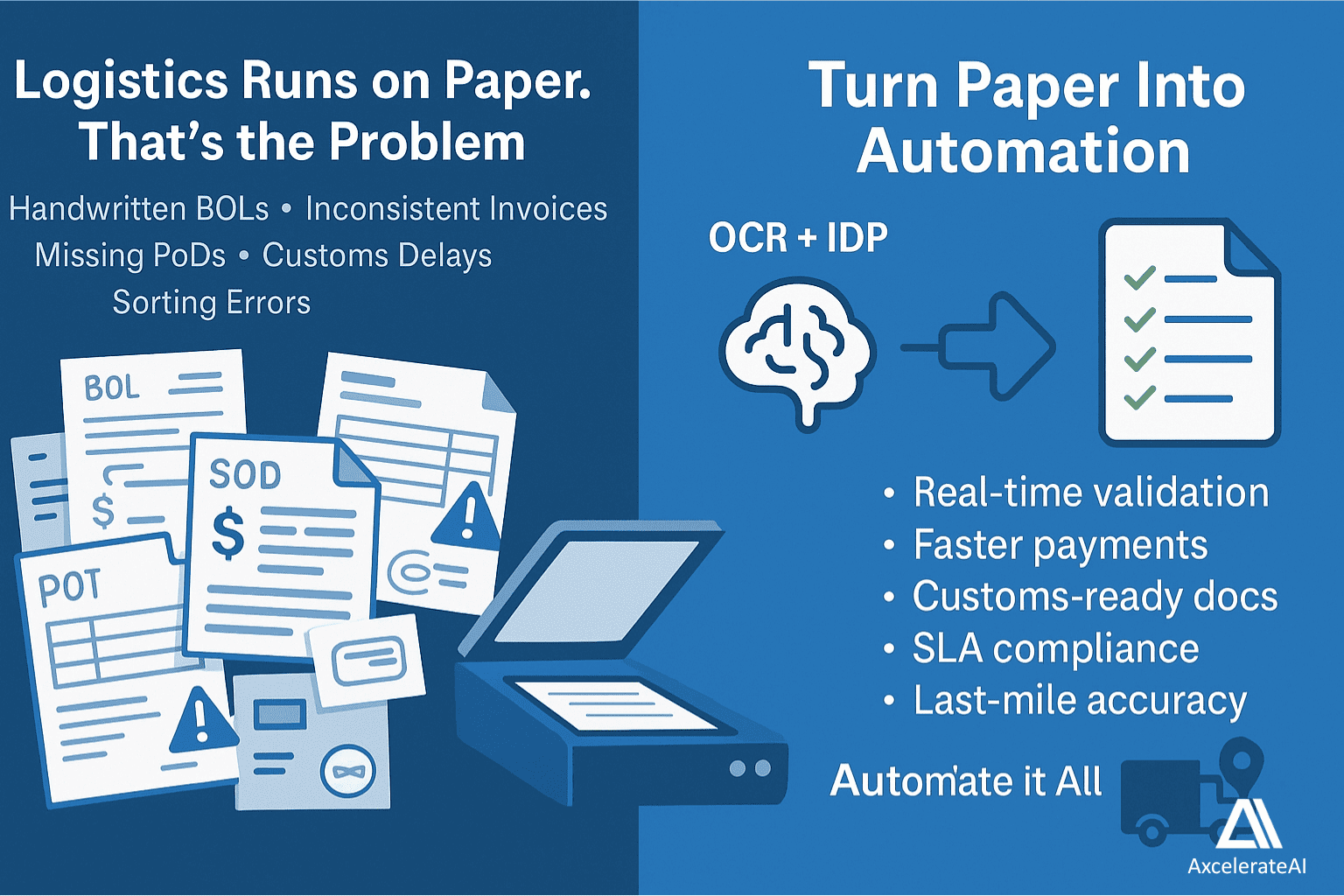
Unlock logistics efficiency with OCR and IDP: Automate inventory, supply chain tracking, and compliance. See real examples from DHL and Maersk.
Unlock PropTech automation. Learn how our custom AI uses Computer Vision and geometric reasoning to extract data from floor plans, reducing costs.
Automate grading, curriculum mapping, and student records. See 5 top use cases where IDP and OCR transform academic operations.
Unlock logistics efficiency with OCR and IDP: Automate inventory, supply chain tracking, and compliance. See real examples from DHL and Maersk.

AxcelerateAI offers cutting-edge AI solutions, specialising in building and deploying custom machine learning models to help businesses optimise operations, enhance decision-making, and drive growth.