85%
Abstraction Time Savings
99.5%
OCR Character Accuracy
5-10×
Material ROI
The Blueprint
AI-Driven Processing Architecture
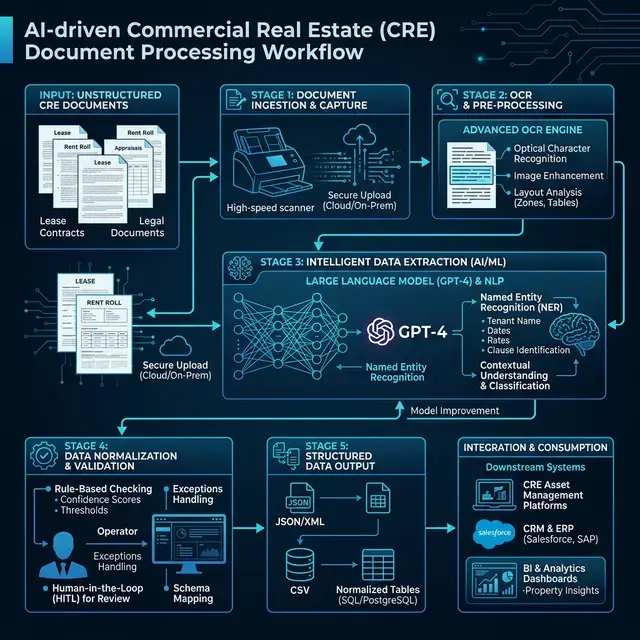
Visualizing the transformation from unstructured legacy documents to industrial-grade datasets and actionable dashboards.
The same pipeline powers our AI lease abstraction and OCR work and our broader intelligent document processing solutions, including offering memorandum parsing.
CRE document processing workflow
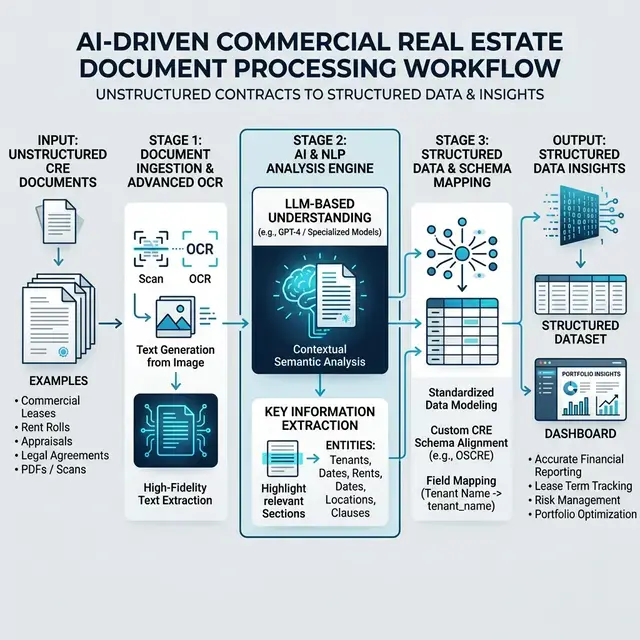
Ingestion
Batch upload PDFs or high-speed hardware scanning.
Analysis
Transformer-based NLP parses legal clauses.
Mapping
Canonical schema alignment (OSCRE standard).
Insight
API export to Yardi, MRI, or BI tools.
Smart Extraction in Action
Our AI handles irregular tables and handwritten notes with ease, mapping them to a clean JSON schema with high confidence thresholds.
Sample lease excerpt to extracted fields (illustrative)
Source Lease Excerpt
Scanning active
THIS LEASE (the "Lease") is entered into this 10th day of June, 2024, by and between TECH TOWER LLC ("Landlord") and CLOUDSTREAM CORP ("Tenant").
The Commencement Date shall be July 1, 2024, for a term of sixty (60) months ending on June 30, 2029.
Basic Rent shall be paid in the amount of $120,000.00 per annum, payable monthly...
Extracted fields
- Lessor Name
- Tech Tower LLC
- Lessee Name
- CloudStream Corp
- Term Duration
- 60 Months (5 Years)
- Expiration Date
- 2029-06-30
- Base Annual Rent
- $120,000.00
99.8%
Model Confidence
The Technical Advantage
Why industrial-grade firms choose our document intelligence engine.
Neural OCR Backbone
Our engine fixes skewed scans and low-contrast text automatically, ensuring 99.5% accuracy before AI extraction.
Semantic Cross-Check
Cross-references rent roll math against underlying lease agreements to identify material discrepancies in real-time.
Proprietary Transformer Layer
We utilize fine-tuned LLMs trained specifically on complex CRE legal terminology and regional lease structures.
Yardi & MRI Integration
Cleaned data flows directly into your asset management systems via secure API or customized Excel/JSON exports.
Frequently Asked Questions
Expert insights on AI document intelligence.
Our state-of-the-art models routinely achieve 90–97% accuracy on standard lease fields. For character recognition (OCR), we maintain 99.5%+ accuracy even on legacy scans or handwritten addenda. We employ an 'AI-first, human-verify' workflow for non-standard or complex legal contingencies.
Yes. The engine doesn't just extract; it validates. It cross-checks rent roll entries against original lease terms to flag 'rent math' inconsistencies, missing renewals, or concessions that weren't correctly applied in your accounting system.
Data security is non-negotiable. Our solutions feature end-to-end encryption, SOC 2 Type II compliance standards, and detailed audit logs. We can deploy these pipelines on your private cloud environment or even on-premise to ensure full data governance.
Beyond 85% labor savings, the material ROI comes from risk mitigation. Firms often recover 5–10× their investment within a single deal cycle by catching hidden co-tenancy risks, missed escalations, or security deposit errors that humans miss during manual audits.
Pilot extractions can be running within days. A full enterprise-grade integration into your existing Yardi or MRI ecosystem typically takes 8–12 weeks, including model fine-tuning for your specific portfolio's document structures.
Ready to Unlock Your Document Data?
Join the forward-thinking firms achieving 10× ROI with AI-powered contract intelligence.