Graph Neural Networks (GNNs) have emerged as a powerful tool in artificial intelligence and machine learning, offering novel ways to model complex relationships within data. Unlike traditional neural networks, which operate on fixed-size inputs, GNNs are designed to work with graph-structured data, making them highly versatile and applicable across various fields. This article delves into the essence of GNNs, their core principles, practical applications, and a real-world case study, providing a comprehensive understanding of this cutting-edge technology.
Graph Neural Networks are a type of neural network explicitly designed to handle graph-structured data. In a graph, data is represented as nodes (vertices) connected by edges, capturing the relationships and interactions between different entities. This structure allows GNNs to leverage the inherent connectivity and dependencies within the data, enabling more nuanced and sophisticated analyses.
GNNs extend traditional neural networks by incorporating two main operations: message passing and aggregation. During message passing, nodes exchange information with their neighbours, allowing each node to gather contextual information. Aggregation then combines these messages to update the node's representation, effectively capturing both local and global patterns within the graph. This iterative process continues for several layers, gradually refining the node representations to capture complex relationships.
The flexibility of GNNs lies in their ability to handle various types of graphs, whether they are directed or undirected, weighted or unweighted, and even dynamic over time.
One of the most prominent applications of GNNs is in social network analysis. Social networks are inherently graph-structured, with individuals represented as nodes and their interactions as edges. GNNs can analyze these networks to uncover hidden patterns, detect communities, and predict future connections. For instance, platforms like Facebook and LinkedIn use GNNs to recommend new friends or connections based on the existing network structure.
In molecular biology, GNNs play a crucial role in predicting the properties and interactions of molecules. Molecules can be represented as graphs, with atoms as nodes and chemical bonds as edges. This capability is particularly valuable in drug discovery, where researchers use GNNs to screen vast libraries of chemical compounds for potential therapeutic properties, significantly accelerating the drug development process.
GNNs are revolutionizing recommendation systems by enabling more personalized and accurate suggestions. GNNs can model the entire user-item interaction graph, considering not just direct interactions but also the influence of other users and items in the network. For example, e-commerce platforms like Amazon leverage GNNs to provide tailored recommendations.
A compelling real-world application of GNNs can be found in the financial sector, particularly in fraud detection. Financial transactions form a complex graph, with accounts, transactions, and entities interconnected in intricate ways. Detecting fraudulent activity within this network requires understanding the subtle relationships and patterns that may indicate suspicious behaviour.
A major financial institution implemented a GNN-based system to enhance its fraud detection capabilities. By considering the connections between accounts, transaction sequences, and associated metadata, the GNN could discern anomalous behaviors indicative of fraud. The GNN system significantly improved the institution's ability to detect fraudulent transactions in real-time.
Despite their promising capabilities, GNNs face several challenges:
Looking ahead, the future of GNNs appears bright, with numerous exciting directions for further exploration, including integrating GNNs with reinforcement learning and generative models.
Graph Neural Networks represent a significant advancement in machine learning, offering unparalleled capabilities for modelling complex relationships across diverse domains, from social networks and molecular biology to large-scale fraud detection in finance. If your organization deals with interconnected data—whether financial transactions, social graphs, or supply chains—and is ready to leverage this cutting-edge technology, contact us to explore GNN development for your enterprise and unlock its full potential.

Unlock PropTech automation. Learn how our custom AI uses Computer Vision and geometric reasoning to extract data from floor plans, reducing costs.

.png)
Automate grading, curriculum mapping, and student records. See 5 top use cases where IDP and OCR transform academic operations.
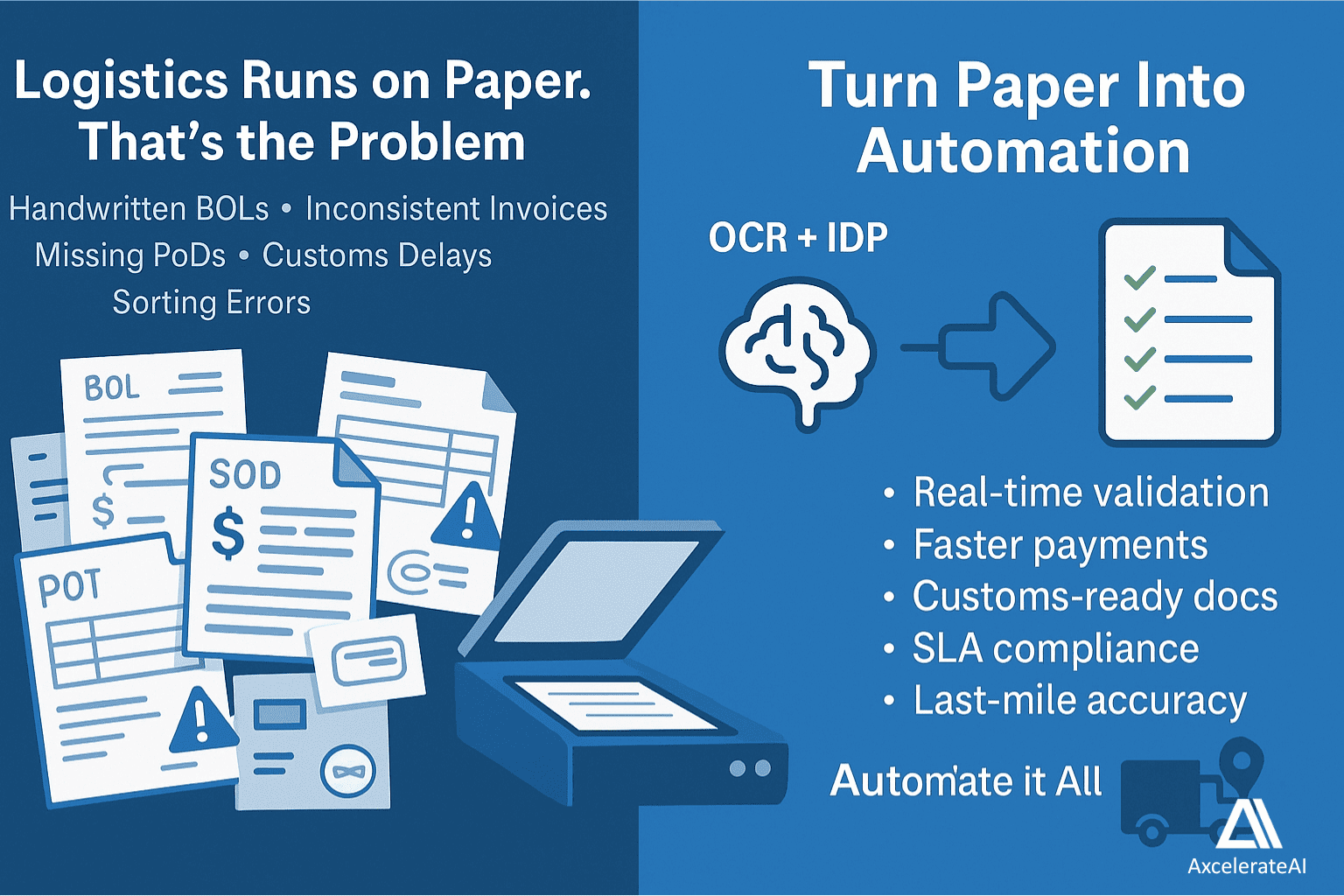
Unlock logistics efficiency with OCR and IDP: Automate inventory, supply chain tracking, and compliance. See real examples from DHL and Maersk.
Unlock PropTech automation. Learn how our custom AI uses Computer Vision and geometric reasoning to extract data from floor plans, reducing costs.
Automate grading, curriculum mapping, and student records. See 5 top use cases where IDP and OCR transform academic operations.
Unlock logistics efficiency with OCR and IDP: Automate inventory, supply chain tracking, and compliance. See real examples from DHL and Maersk.

AxcelerateAI offers cutting-edge AI solutions, specialising in building and deploying custom machine learning models to help businesses optimise operations, enhance decision-making, and drive growth.