Imagine a packed radiology department where hundreds of scans arrive every day. A tired doctor reviews a mammogram and almost misses a faint shadow that could signal early breast cancer. Seconds later, an AI quietly highlights the exact spot with 94% confidence, prompting a second look that changes everything. This is happening today at places like UCSF, and it’s just one example of how artificial intelligence in healthcare is transforming medicine.
From spotting diseases in X-rays faster than any human, to building personalized treatment plans with tools like IBM Watson, to tracking glucose levels in real time for diabetes patients, AI is making healthcare more accurate, faster, and more human. It processes millions of data points in moments, catches patterns doctors might overlook, and frees medical teams to focus on patients instead of paperwork.
This article explores the most impactful real-world AI Solutions for healthcare (diagnostics, personalized care, monitoring, and administration), the challenges we still face, and what the future holds.
AI's integration into healthcare has led to significant advancements in several areas, including diagnostics, treatment planning, patient care, and administrative tasks.
One of the most promising applications of AI in healthcare is in the field of diagnostics. Machine learning algorithms can analyze medical images, such as X-rays, MRIs, and CT scans, to detect anomalies that might be indicative of diseases such as cancer, cardiovascular conditions, or neurological disorders. AI systems can often identify patterns that are not immediately apparent to the human eye, leading to earlier and more accurate diagnoses.
For example, Google's DeepMind developed an AI algorithm that can analyse retinal scans to detect more than 50 different eye diseases with high accuracy. This kind of precision aids in early detection and treatment, potentially preventing severe outcomes and improving the quality of life for patients.
AI can analyze vast amounts of patient data to help develop personalized treatment plans. By examining historical data and outcomes, AI systems can predict which treatments are likely to be most effective for individual patients. This approach is particularly beneficial in managing chronic diseases, where treatment effectiveness can vary significantly from patient to patient.
IBM Watson, for instance, uses AI to assist oncologists in identifying personalised cancer treatments. By analyzing medical literature, clinical trial data, and patient records, Watson can provide evidence-based treatment recommendations tailored to each patient's unique genetic makeup and medical history.
AI technologies are also being utilized to enhance patient care and monitoring. Wearable devices and mobile apps can collect real-time health data, such as heart rate, blood pressure, and glucose levels, which can then be analyzed by AI to monitor patient health continuously. These systems can alert healthcare providers to potential issues before they become critical, enabling timely interventions.
One notable example is the use of AI in managing diabetes. The AI-driven app, BlueLoop, developed by the Diabetes Patient Advocacy Coalition, helps patients track their glucose levels, diet, and insulin usage. The app provides real-time feedback and suggestions to help patients manage their condition more effectively, reducing the risk of complications.
Beyond direct patient care, AI is playing a significant role in streamlining administrative processes within healthcare institutions. AI-powered systems can automate routine tasks such as scheduling appointments, processing insurance claims, and managing medical records. This not only reduces the administrative burden on healthcare staff but also minimizes the risk of human error and ensures that patient data is managed efficiently. For example, Olive AI offers a suite of tools designed to automate healthcare administrative tasks. Hospitals and clinics using Olive AI have reported substantial reductions in time spent on paperwork, allowing healthcare professionals to focus more on patient care.
One compelling case study highlighting the impact of AI in healthcare is its application in radiology. The University of California, San Francisco (UCSF) implemented an AI-based system to assist radiologists in interpreting mammograms. Breast cancer screening using mammograms can sometimes result in false positives or false negatives, leading to unnecessary anxiety or missed diagnoses. The AI system at UCSF was designed to mitigate these issues by providing an additional layer of scrutiny. This system was meticulously trained on thousands of mammogram images, allowing it to recognise subtle patterns associated with breast cancer that might be overlooked by the human eye.
When put to the test, the AI system demonstrated a remarkable ability to detect breast cancer with higher accuracy than human radiologists. It wasn't just a standalone tool but a supportive partner in the diagnostic process. The AI would flag suspicious images, prompting radiologists to take a closer look and potentially reconsider their initial assessments. This synergy between AI and human expertise resulted in more accurate diagnoses and significantly reduced the chances of false positives and negatives. Consequently, patients received more reliable information, which alleviated unnecessary anxiety and ensured that those needing treatment were identified promptly.
The collaboration between AI and radiologists at UCSF represents a significant advancement in healthcare diagnostics. By leveraging AI's pattern recognition capabilities and the nuanced judgment of human experts, the process of interpreting mammograms became more robust and reliable. Early detection of breast cancer is crucial for successful treatment outcomes, and the AI system's contribution to earlier and more accurate diagnoses holds the potential to save many lives. This case study not only underscores the transformative impact of AI in healthcare but also highlights the importance of integrating technology with human skills to enhance medical practices.
While the benefits of AI in healthcare are significant, there are also challenges and ethical considerations that need to be addressed.
Firstly, healthcare data is highly sensitive, and the use of AI involves processing vast amounts of this data. Ensuring the privacy and security of patient information is paramount. Robust measures must be in place to protect data from breaches and misuse. Healthcare institutions must comply with regulations such as the Health Insurance Portability and Accountability Act (HIPAA) to safeguard patient information.
Secondly, AI systems are only as good as the data they are trained on. If the training data is biased, the AI system can perpetuate and even exacerbate these biases. This is particularly concerning in healthcare, where biased algorithms can lead to disparities in treatment and outcomes. It is crucial to ensure that AI systems are trained on diverse and representative data sets and to continuously monitor and address any biases that may arise.
Lastly, integrating AI into existing healthcare systems can be challenging. Healthcare providers need to be trained to use these new technologies effectively. Moreover, there may be resistance to adopting AI due to concerns about job displacement or the reliability of AI-generated recommendations. Building trust and demonstrating the efficacy of AI systems through clinical trials and real-world applications is essential for widespread acceptance.
The future of AI in healthcare is promising, with ongoing advancements poised to further enhance medical services and patient care. Researchers are exploring the use of AI in areas such as drug discovery, where AI algorithms can identify potential new treatments more quickly and cost-effectively than traditional methods. AI is also being used to predict disease outbreaks and manage public health responses, as seen during the COVID-19 pandemic.
As AI technology continues to evolve, its integration into healthcare will likely become more seamless, with AI systems becoming indispensable tools for medical professionals. The key to maximizing the benefits of AI in healthcare lies in addressing the challenges and ethical considerations while fostering collaboration between AI and human expertise.
From catching cancer earlier in a mammogram to helping a diabetic patient avoid a midnight emergency, AI in healthcare is already saving lives every day. It gives doctors superhuman pattern recognition, turns mountains of data into personalized treatment plans, and cuts the paperwork that steals time from patients.
The evidence is undeniable: faster diagnoses, fewer mistakes, lower costs, and better outcomes. Places like UCSF, Google DeepMind, and IBM Watson aren’t waiting for the future — they’re living it right now. Interested in advanced AI development services to achieve measurable improvements in patient outcomes? It's time for scheduling AI Consulting Services to explore how AI enhances healthcare.

Unlock PropTech automation. Learn how our custom AI uses Computer Vision and geometric reasoning to extract data from floor plans, reducing costs.

.png)
Automate grading, curriculum mapping, and student records. See 5 top use cases where IDP and OCR transform academic operations.
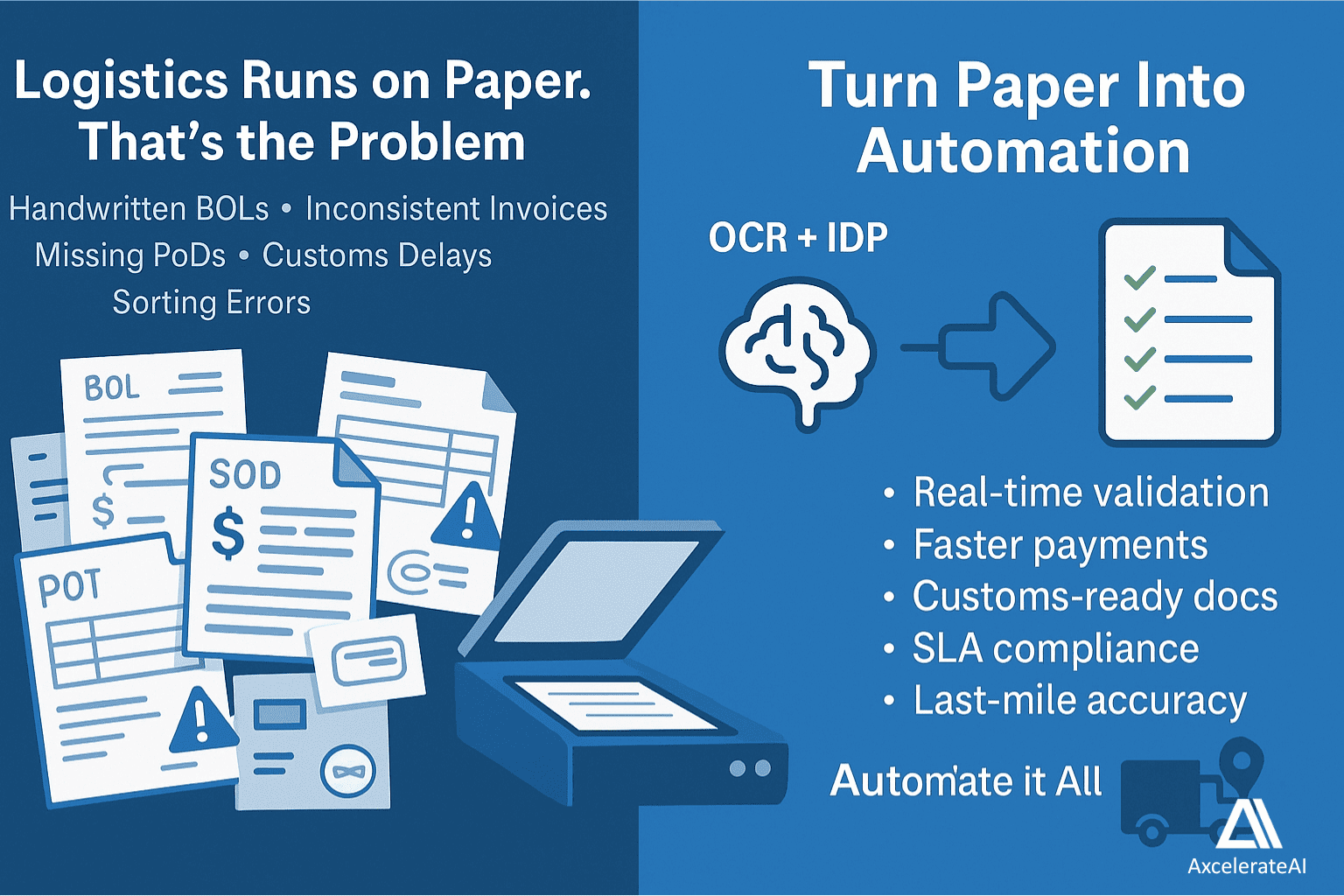
Unlock logistics efficiency with OCR and IDP: Automate inventory, supply chain tracking, and compliance. See real examples from DHL and Maersk.
Unlock PropTech automation. Learn how our custom AI uses Computer Vision and geometric reasoning to extract data from floor plans, reducing costs.
Automate grading, curriculum mapping, and student records. See 5 top use cases where IDP and OCR transform academic operations.
Unlock logistics efficiency with OCR and IDP: Automate inventory, supply chain tracking, and compliance. See real examples from DHL and Maersk.

AxcelerateAI offers cutting-edge AI solutions, specialising in building and deploying custom machine learning models to help businesses optimise operations, enhance decision-making, and drive growth.