TL;DR: This article explores how machine learning is helping marketing teams forecast the success of their campaigns. We discuss the transition from reactive strategies to predictive analytics, the mechanics of building a forecasting model using diverse ML techniques, and the benefits of applying AI to creative asset analysis. Finally, we highlight the tremendous advantages of opting for a custom AI solution trained on your specific brand guidelines and historical data.
Marketers traditionally learn how well a campaign worked after it’s over, making budget decisions on “rearview” data. As one industry expert observes, teams can end up “making million-dollar decisions based on rearview mirror data”. AI-driven predictive analytics changes this model entirely. By training on historical campaign data (customer behavior, past ad performance, seasonality, etc.), machine learning models can forecast key metrics — like conversions, revenue, or engagement — before you spend a dollar. For teams exploring an AI audit or leveraging managed services to deploy these models—much like those seen in our case studies—predictive analytics is “the difference between driving with GPS versus an outdated map”: it turns guesswork into foresight, so you plan with confidence rather than react to surprises.
Predictive marketing analytics leverages existing data – past sales, CRM records, web and ad analytics – to train models that project future results. All relevant metrics (clicks, impressions, opens, demographics) are fed into statistical algorithms that identify hidden patterns. For example, AI might learn that email open rates above 25% and Instagram ad click-through spikes in late summer consistently precede a sales surge. By simulating proposed campaigns with these models, marketers can estimate KPIs like conversion rate, return on ad spend (ROAS), or customer lifetime value before launching any new ad. This turns planning into a data-driven experiment, where each campaign variant can be evaluated in advance.
How It Works: Building the Predictive Model
At a technical level, pre-launch forecasting combines data science with marketing expertise. First, all historical campaign data are collected and cleaned – this might include ad spend and creative details from each channel, landing page traffic, past conversion results, and even external factors like seasonality or market trends. The data must be consolidated (e.g. from Google Analytics, social media reports, CRM) and pre-processed so the model can understand it. Once the dataset is ready, various machine learning techniques are applied:
- Regression models (linear or logistic) predict numeric outcomes. For instance, a linear regression might forecast how total campaign revenue scales with budget; a logistic regression might estimate the probability that a lead will convert.
- Classification trees and ensembles (decision trees, random forests, gradient boosting) categorize campaigns or ads. For example, a model could classify whether a campaign will exceed its ROI target. These can capture non-linear relationships between ad features and success.
- Clustering and segmentation algorithms (like k-means) group customers or campaigns by similar traits. This helps identify the most profitable audience segments or common characteristics of high-converting campaigns.
- Time-series analysis models focus on trends and seasonality. If a product sells more around holidays, the model learns that pattern to forecast future peaks.
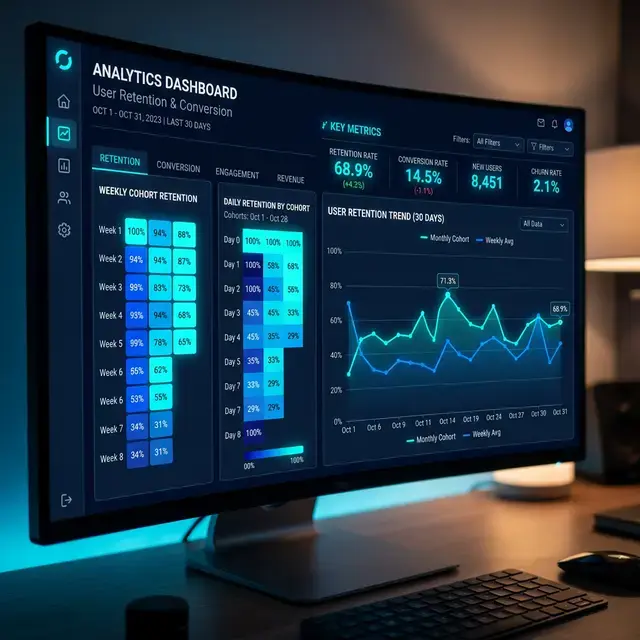
After building the model, it’s rigorously tested on held-out data: typically 70-80% of records train the model, and 20-30% are used for testing. Cross-validation ensures the model performs consistently. Evaluation metrics depend on the model type: for regressions we look at mean absolute error or R-squared; for classifications we monitor accuracy, precision, and recall. Modern forecasting tools often output ranges or probabilities rather than single-point guesses. For example, instead of saying “This campaign will make $50,000,” a strong model might say “This campaign is likely to generate between $45,000 and $55,000 with 95% confidence”. It also reports feature importance scores, revealing which factors (such as audience size, ad creative style, timing, or channel) drive results. A marketer might discover, for instance, that audience demographics contribute 40% to the prediction, while ad copy type contributes 25%. Such insights directly guide where to focus improvements.
Finally, the trained model becomes a forecasting engine. You input the details of a proposed campaign (target audience, channels, creatives, budget allocations), and the AI returns predicted outcomes – conversion rates, engagement levels, ROAS, etc. This lets teams compare scenarios head-to-head before launch. Instead of launching blindly, you can ask, “If we double the Instagram budget or use Video A vs Video B, what will happen?” A well-implemented system lets you answer these questions in minutes. The result is a shift from hindsight to foresight: you no longer ask “what happened?”, but “what will likely happen next?”.

AI-Powered Creative Asset Analysis
Predictive forecasting isn’t limited to numbers. Advanced AI can also evaluate the creative assets – images, video, copy – that make up a campaign. Imagine feeding your previous ad images and headlines into an AI model that learns what visual and verbal elements drive engagement. Computer vision and natural language processing (NLP) enable this deeper analysis. For example, AI might learn that in your brand’s past campaigns, ads with bright colors and smiling faces performed best, whereas dark or overly-styled images underperformed. It can score each new image on factors like color usage, emotional tone, composition, and even facial expressions. Similarly, NLP models can analyze headline length, sentiment, or phrasing to see what resonates with your audience.
These AI “creative insight” tools use predictive analytics to forecast asset performance before launch. They ingest historical data (impressions, clicks, time-on-page, conversion lift) and correlate it with asset attributes (image style, video format, text length, etc.). For instance, the AI might discover that for your customer base, “ads featuring people in natural settings outperform product-only images”. Armed with that insight, you could choose or even generate the more effective creative. In practice, the AI might run dozens of hypothetical A/B tests in parallel: swapping colors, fonts, or images algorithmically, and predicting which variant will drive higher click-through rates or conversions. Modern systems can even use generative AI to suggest new copy or image edits, then score those variants on the fly. This approach drastically reduces costly trial-and-error in real campaigns.
- Automated multivariate testing: AI can generate dozens of ad variations (changing colors, layouts or headlines) and evaluate them instantly to surface the highest performers.
- Continuous learning: As audience data comes in (even from other campaigns), the AI updates its understanding in real time, improving its predictions. Over time it learns which creative tweaks (like adding a call-to-action vs. using a testimonial) most increase conversions.
- Brand consistency enforcement: Crucially, these AI tools can be custom-trained on your brand guidelines. By feeding the AI your logo files, color palette, typography rules, and examples of on-brand messaging, it becomes a “virtual brand guardian.” The model will flag off-brand elements (wrong fonts, unauthorized imagery, off-tone language) before you launch. Brands using such tailored AI models report up to a 37% increase in audience trust and recognition, because every ad, email, or social post stays true to the brand voice. In short, AI helps you choose (or create) the most effective assets and ensures they align with your style guide.
Benefits of Pre-Launch AI Forecasting
Implementing an AI forecasting system yields clear payoffs for marketers:
- Maximized ROI: By identifying the most promising channels, audiences, and creatives before launching, you allocate budget to winners and cut losses early. Studies show that optimizing all channels with AI-driven predictions can improve marketing ROI by roughly 15–20%. In practice, companies “scale winners faster, cut losers sooner, and stop wasting budget on campaigns that were never going to deliver”.
- Reduced wasted spend: Instead of waiting weeks to see poor performance, the AI forecast acts as an early warning system. If a planned campaign variant is predicted to underperform, you can revise or cancel it pre-launch. As one guide notes, this proactive approach “compresses decision cycles and reduces wasted spend” by spotting issues beforehand.
- Faster iteration and learning: Predictive models dramatically speed up testing. What used to take multiple live A/B tests can now be evaluated in silico. Teams can iterate creative ideas and targeting hypotheses in hours, not weeks, continually refining their strategy based on AI recommendations.
- Personalization and targeting: With forecasting, you can match creative to specific segments that the model predicts will respond best. AI insight into audience preferences enables hyper-personalized campaigns. Marketers see higher engagement (click-through and time-on-page) when ads are tailored by AI to each segment. Similarly, predicted high-value customer groups can be identified and targeted before a campaign starts.
- Brand consistency and efficiency: Custom AI models ensure every predicted asset adheres to your brand’s guidelines. This slashes the time spent on manual brand-checking; teams report saving up to 51% of their copywriting and design review time with brand-trained AI tools. Automated compliance means fewer off-brand mistakes and faster rollout of campaigns — even across multiple regions or languages.
Overall, AI forecasting turns marketing planning into a more scientific, data-driven process. Instead of hoping for the best, CMOs can base decisions on quantified likelihoods. This not only boosts confidence in scaling successful campaigns but also builds a continuous feedback loop: real results get fed back into the model, improving future predictions.
Who Uses This Technology?
The adoption of AI for campaign forecasting is growing rapidly among forward-thinking brands, agencies, and high-growth companies. Leading firms already use predictive analytics daily to fine-tune budgets and messaging. By 2025, an estimated 75% of top-performing marketing teams will be using predictive analytics. Big companies often integrate AI into their marketing tech stack or partner with specialist agencies. For example, a retail giant might use an AI agent to optimize Black Friday ads, while a travel company runs simulations on seasonal demand shifts. Performance marketing agencies increasingly offer AI-powered forecasting as part of their services, recognizing that clients expect data-backed strategies.
Smaller teams and mid-market businesses are also getting in on this. Modern tools and cloud platforms make it possible to apply machine learning without building a full data science team. Even a single CMO or marketing analyst can feed their own data into SaaS AI tools or work with vendors to build a lightweight predictive model. The key is having good data: campaign histories, customer logs, and clear objectives. As one expert notes, “you don’t need a team of data scientists or enterprise budgets to start using predictive analytics” – many platforms offer no-code predictive features that developers and marketers can adopt.
Why a Custom AI Solution?
While the concept of AI-driven forecasting is powerful, one size does not fit all. Off-the-shelf tools and dashboards can provide generic insights, but a custom AI solution tailored to your brand will perform better. Custom models are built from the ground up on your data and integrate your unique business logic. They can be fine-tuned with your historic campaigns, specific KPIs, and even your brand’s creative guidelines. This alignment means the AI truly “understands” your market: it’s more accurate at predicting outcomes because it has been trained on exactly the kind of campaigns and customers you have.
There are several reasons to go custom:
- Data Ownership and Relevance: A custom model uses your proprietary data (first-party customer behavior, sales, campaign results) rather than relying on third-party averages. This yields more relevant predictions. In fact, 92% of organizations report that custom AI delivers superior ROI compared to generic tools.
- Integration with Brand Guidelines: As discussed above, you can train the AI on your logo, color palette, tone of voice and approved content. This ensures the model’s recommendations stay on-brand. Companies using tailored brand-AI tools see significantly higher audience trust and recognition. Off-the-shelf solutions simply cannot enforce these nuances.
- Perfect Fit and Flexibility: Custom systems are designed to fit your exact workflows and goals. They can be hosted on your cloud or on-premises for security, linked directly to your marketing stack (CRM, ad accounts, email platforms), and updated as your strategies evolve. This “perfect fit” means no compromises – unlike generic products that only cover broad cases.
- Competitive Edge: By building a proprietary forecasting engine, you create an asset that competitors don’t have. Custom AI models become a strategic advantage that is hard to replicate. They can continually learn from your ongoing campaigns, compounding benefits over time.
In short, for CMOs and marketing teams serious about data-driven growth, a custom AI solution is the logical next step. It is as much an investment in your brand’s future as it is in your marketing process.
Interested in using AI to forecast your next campaign? Our team builds bespoke AI solutions trained on your brand’s data and guidelines. We can help you simulate campaigns and creatives in advance, so you launch with confidence. Contact AxcelerateAI to discuss your custom marketing AI solution.